Comments
  Print
Print  Mail
Mail  Large Medium Small
Information to serve as source when creating policies to aid the needy
|
 |
|
Students from a teachers' college in Fuyang, Anhui province, donate scarves, woolen sweaters and clothing to impoverished villagers and children to help them cope with the cold winter. Wang Biao / For China Daily |
The central government will compile a national database to better analyze the numbers of Chinese who live in poverty, a senior anti-poverty official said on Wednesday.
The database, which will be regularly updated, particularly with information about the rural poor, will help in shaping policies for individual households and villages, Liu Yongfu, director of the State Council Leading Group Office of Poverty Alleviation and Development, said at a meeting with top legislators in Beijing.
 |
"We will make sure those in need are included in our poverty-reduction project," he said.
Liu said at a separate meeting on Wednesday that the database will record such information as the location of impoverished households, how they fell into poverty and their most pressing needs.
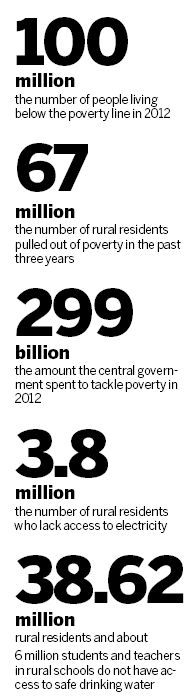
About 100 million of rural Chinese were living below the national poverty line of 2,300 yuan ($379) per year as of 2012, according to Liu's office.
The government is striving to improve how it evaluates poor counties, he said. It is also trying to improve how it helps counties lifted out of poverty by government-led programs to regain self-sufficiency.
Wang Xiaolin, director of the research division of the International Poverty Reduction Center in China, welcomed changes the government is making that will support making the most efficient use of poverty-reduction funds.
According to the State Council Leading Group Office of Poverty Alleviation and Development, about 3.8 million Chinese live in villages without electricity, and more than 44.6 million rural Chinese have no access to safe drinking water.
China has the second-largest number of poor in the world, after India, even though it has lifted about 700 million people out of poverty in the past 30 years, Wang said.
"In the past, most rural residents were poor, and the government only had to develop its economy to reduce poverty," he said, "After years of growth, it has now become vital for the government to find new methods to distinguish who is poor and where they are located."
He said a more precise national database will help China to "avoid the middle-income trap" that has occurred in Latin American countries, which suffer from economic fluctuation and stagnation.
More than 70 percent of the world's poor live in middle-income countries, including China, according to a United Nations report released in 2012.
Li Hui, a poverty reduction official in Heilongjiang province, said local governments often lack the manpower to make house visits and record detailed information on poor households.
He suggests the central government permit grassroots departments to purchase services from social organizations to update the database.
Copyright 1995 - . All rights reserved. The content (including but not limited to text, photo, multimedia information, etc) published in this site belongs to China Daily Information Co (CDIC). Without written authorization from CDIC, such content shall not be republished or used in any form. Note: Browsers with 1024*768 or higher resolution are suggested for this site.
License for publishing multimedia online 0108263 Registration Number: 20100000002731