

 Comments
  Print
Print  Mail
Mail  Large Medium Small
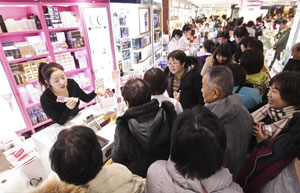
"I follow many Korean TV shows every week and am probably influenced by that. Korean kimchi and bibimbap are among my favorite dishes among all international cuisines," said Elena Wang in a Beijing supermarket where all kinds of Korean foods can be found.
Other Chinese companies said they are simply planning to use South Korea as a springboard for easy access to Korean and global markets.
The Qingdao Nine-Alliance Group, one of China's largest producers and exporters of chicken products, said a production plant in South Korea could help them get closer to the overseas food market, taking advantage of the country's advanced technology and trade experience.
"Our presence in South Korea will provide a good opportunity for us to take off as a global food company because South Korea has made free-trade agreements with many countries, which would help spread our products quickly worldwide," said chief executive Wang Heung Hu of the Qingdao Nine-Alliance Group.
South Korea has signed free-trade agreements with 47 countries and is currently negotiating with China. In contrast, China has been building 18 free-trade zones with 31 countries and areas and has signed free-trade agreements with 12 countries so far.
The consequence is Chinese food companies will enjoy a higher competitive advantage than those at home with lowering trade barriers and the better export experience that South Korea has enjoyed with the US and Europe, experts said.
"Chinese food companies could export their products labeled 'Made in Korea' not only to their domestic market but also to other countries to expand their food exports where there is a growing preference for Korean food," said Ahn Chang-geun, senior deputy director of the Korea National Food Cluster Division at the Ministry of Agriculture, Food and Rural Affairs.
A survey of 2,800 urban families in China revealed that South Korea ranked second after France in satisfaction regarding the processing of food in the countries of its origin. And in the UK, Tesco Plc said, the demand for Korean food has increased by 140 percent over last year.
Chinese companies including Shandong Baohua International Group, a major fertilizer maker and Jilin Sky-Scenery Food Co Ltd, which specializes in corn-based products, as well as international big food producers such as Canada's SunOpta Inc, which specializes in the sourcing, processing and packaging of natural and organic food products, and Japan's Jalux Inc, which specializes in meals for the aviation industry, the circulation of food materials and duty-free shop operations, are all on the list.
So far, 88 companies have signed the memorandum of understanding with Foodpolis. Thirty-eight of them are non-South Korean companies, including nine from China. The first stage of the enterprise is expected to be completed by 2015, according to Foodpolis.
It is a commonly held view that many Chinese food makers have much to accomplish in terms of quality management, technological capability and brand image.
The recent deals by Chinese meat producer Shuanghui International Holdings Ltd to buy the world's biggest pork producer, Smithfield Foods Inc, for $4.7 billion in cash, the largest China-US takeover, to Bright Food (Group) Co Ltd's purchase of British cereal company Weetabix Ltd last year, were efforts by Chinese food companies to make a name for themselves globally by acquiring renowned foreign peers, said He Zhicheng, chief economist at the Agricultural Bank of China.
But after years of investment in overseas countries, critics said that China's food sector may have attached too much importance to the overseas market.
"Building a production base in Korea may be one way to compete with food companies on the international stage, but the question is whether they can fully learn the food technology and safety protocols, an essential factor to help them improve food safety and directly affect competition with other food companies. Because the Chinese have become savvy in choosing imported food, food companies can't win them over simply with a label," added He.
The economist added that some Chinese companies in all sectors would be better off channeling their capital and efforts toward their own home market, which has seen a tremendous demand from its enormous population.
His words were echoed by Lian Ping, who said investing in South Korea is a double-edged sword.
Copyright 1995 - . All rights reserved. The content (including but not limited to text, photo, multimedia information, etc) published in this site belongs to China Daily Information Co (CDIC). Without written authorization from CDIC, such content shall not be republished or used in any form. Note: Browsers with 1024*768 or higher resolution are suggested for this site.
License for publishing multimedia online 0108263 Registration Number: 20100000002731