Comments
  Print
Print  Mail
Mail  Large Medium Small
China's economic planners are taking an increasingly hawkish stance on the overcapacity issue, reportedly mulling a "white list" for the next campaign.
Several central ministries, including the National Development and Reform Commission, Ministry of Industry and Information Technology, Ministry of Land and Resources and Ministry of Environmental Protection, are soliciting opinions on a plan to require local governments to resubmit the names of companies in overcapacity-plagued industries, the China Securities Journal reported Monday.
If a manufacturer of steel, flat glass, cement, electrolytic aluminum or ships doesn't make it onto the list, the company could be shut down, the Journal said, without citing any specific official.
The proposal is the latest to be floated in a massive government program to rein in a growing industrial glut, which, according to President Xi Jinping, risks triggering an economic crisis.
On Oct 15, the State Council issued a "guiding opinion" for solving the overcapacity issue. Projects that had not started construction before the document was announced, it said, should be canceled. Projects on which construction had started should not continue unless they receive central government approval.
In early November, the head of the nation's banking regulator said that new forms of credit would be cut for start-up projects in industries facing severe overcapacity.
"If unchecked, overcapacity will aggravate the vicious competition, enlarge the industrial losses, increase banks' non-performing assets, and waste material and human resources," warned the State Council's document.
The latest plan, the Journal said, sets standards in areas such as land use permits, environmental impact and energy consumption to keep out unqualified companies.
But industrial analysts were doubtful as to whether the policies would take effect.
"Companies will try any means to secure a place on the 'white list,' " said Zhang Lin, an analyst with the Lange Steel Information Research Center. "The government should make these specifications very transparent so the making of the list is a rule-based process."
Analysts said setting various thresholds is hardly a new idea, and has yielded few results in the past. Execution at the local government level remains a problem, since those mired in excessive capacity are large employers and taxpayers. And even if specifications are executed to the letter, the government can't always keep a close eye on these companies.
"Many factories that installed eco-friendly equipment simply don't use it when local regulators are away because it is costly. [And] government cannot always be there," Zhang said.
As a result, although China's economic planners have sought to rein in the steel industry since at least 2004, annual capacity has risen to 970 million metric tons, according to the China Iron and Steel Association, exceeding the industry's output by 35 percent in 2012. China produces seven times more than Japan, the world's second-largest producer.
Now, although the steel industry's capacity utilization rate has fallen to 72 percent, it did not prevent Chinese companies from churning out steel, despite huge losses.
By the end of June, 86 major steel companies across China had posted a total loss of 3 trillion yuan ($489 billion). And the combined profits of those companies in the first half of the year totaled only 2.2 billion yuan, according to CISA.
Zhang said that while it is preferable to phase out overcapacity via market forces, the market hasn't worsened enough to force the bankruptcy of steel companies.
After many companies opted to run at a low capacity, the situation got slightly better earlier this year.
The problem, however, is that they might scale up production again once the situation improves.
 Jimmy Lin Zhiying, models at Toyota pavilion
 Volvo all-new S60L world premiere at Guangzhou auto show
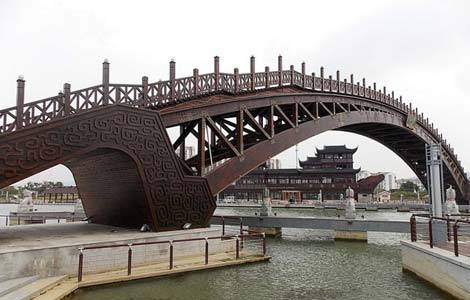 Largest span timber arch bridge
 Porsche 911 Turbo S Asian premiere fascinates Auto Guangzhou
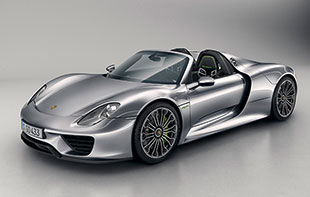 Auto Guangzhou witnesses new Porsche sports cars Asia Premiere
 2013 Guangzhou auto show carmakers' eventers
 Models at Volvo pavilion at 2013 Guangzhou auto show
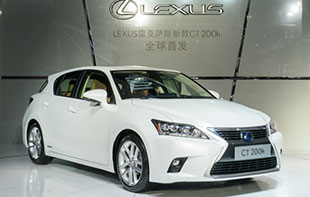 Lexus new hybrid hatch CT200h world premiere in Guangzhou
Copyright 1995 - . All rights reserved. The content (including but not limited to text, photo, multimedia information, etc) published in this site belongs to China Daily Information Co (CDIC). Without written authorization from CDIC, such content shall not be republished or used in any form. Note: Browsers with 1024*768 or higher resolution are suggested for this site.
License for publishing multimedia online 0108263 Registration Number: 20100000002731