Comments
  Print
Print  Mail
Mail  Large Medium Small
The plenary session communique charts a clear path for development. But since the statement is largely an abstract, we do need to wait for another week to see whether detailed plans really touch tough issues such as state monopolies, financial reform, easing investment and curbing government powers. What is most important, of course, is to see the guidelines translated into reality in the coming years.
But since policymakers have shown their determination to press ahead with reform, they must have at least three things in mind.
First, GDP growth is not a priority any more. Although it is believed that China does need a certain amount of growth to ensure employment and social stability, it must be understood that the country, after withstanding the tests brought on by the 2008-09 financial crisis, is more willing to accept slower growth. The trade sector, in particular, has honed its skills in dealing with shrinking orders and economic slowdown.
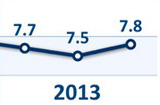
Given that China's job market remained resilient during the economic slowdown this year, top policymakers should revise down GDP growth forecasts to 7 percent next year, from this year's 7.5 percent. By doing so, they can send out a strong signal that economic quality instead of quantity is what the country needs most urgently.
The soft landing from 7.5 percent to 7 percent will not take a heavy toll on jobs if measures to reform and boost the service sectors gather pace.
Generally, the country can provide enough jobs for its huge but shrinking labor force. But the real problem is structural in that it features insufficient service-sector jobs for its increasingly better-educated workforce, as seen in the difficulty for fresh university graduates to find jobs this year. In this sense, it is not overall GDP growth that matters to the jobs market. Instead, how fast the government is going to develop the service sector, by, among other things, cutting red tape, widening access to foreign and private investors and facilitating funding, will determine the future of the job market.
Second, breaking up State monopolies in major industries is a pressing matter.
In this there is likely to be stiff resistance from interest groups, but this hard nut must be cracked because monopolies hinder efficiency and creativity, widen the wealth gap and distort distribution of social and economic resources.
Successful reforms in this regard will raise productivity growth, helping sustain China's relatively high growth (6 to 8 percent) in the medium-term and promote more inclusive growth.
To achieve this, the government's desire to ease entry barriers for private investors and allow private capital to invest in several State-dominated sectors such as the railways, utilities, medical and telecom industries must be translated into action.
Third, policymakers must refrain from stimulus measures. Practice has proven that investment and liquidity-centered stimulus creates more problems than it solves.
The authors are Shanghai-based financial analysts. The views do not necessarily reflect those of China Daily.

 NE China's Jilin issues yellow alert for blizzards
 Dujiangyan restores traditional meeting etiquette
Copyright 1995 - . All rights reserved. The content (including but not limited to text, photo, multimedia information, etc) published in this site belongs to China Daily Information Co (CDIC). Without written authorization from CDIC, such content shall not be republished or used in any form. Note: Browsers with 1024*768 or higher resolution are suggested for this site.
License for publishing multimedia online 0108263 Registration Number: 20100000002731