Comments
  Print
Print  Mail
Mail  Large Medium Small
The benefits of reform and opening up should be enjoyed by all people. A first-come-first-served and winners-take-all situation should be avoided, said Zheng Yongnian, professor at National University of Singapore.
China currently has approximately 260 million migrant workers, mostly farmers who have left their families to forge a living in cities. About 10 million rural residents are expected to move to urban areas every year in the coming decade.
The newcomers generate huge consumption and investment demand, but the residence registration, or hukou system, prevents them from gaining access to education, social welfare and heath care in cities. Back in their home villages, farmers cannot sell land freely, but the land might be grabbed by local governments for development. In most cases, farmers only get a fraction of the market value as compensation due to the prevailing land policies.
Analysts noted that as the government pushes urbanization, it should break down the hukou system and give farmers more rights to the land as ways to solve public service inequality and ease public anger.
Chi said China's distribution of wealth and interests is still not fixed, which means the window stays open for reforms. Zhu Haibin, chief China economist at JPMorgan Chase & Co, said there are difficulties in pushing forward reforms. However, the political pressure is much less compared with 30 years ago and the government should take actual measures to deepen reforms on all fronts.
Leadership determination
Judging by recent remarks by senior leaders, the central government is determined to make breakthroughs in reshaping the distribution of interests.
China must break the barriers from entrenched interest groups to further free up social productivity and invigorate creativity, said President Xi Jinping when visiting Hubei Province in July. The country must deepen reforms in major areas with "ever more political courage and wisdom" to surmount the institutional barriers that are restraining growth, Xi stressed.
Premier Li Keqiang has unveiled a new round of economic reforms since he took office in March. He acknowledged such reforms "will be very painful and even feel like cutting one's wrist," but he stressed that the central government would honor its commitments when addressing the Summer Davos Forum in September.
Under the new leadership, the State Council, or China's cabinet, has abolished a slew of administrative approvals and transferred supervision to lower-level government bodies to streamline governance and reduce government intervention in the market.
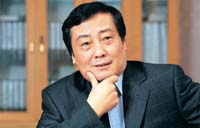
HNA's Chen hailed the measures. "The market in most circumstances can serve as an effective mechanism in distributing interests in a fairly Darwinian manner," he said.
Government reforms can bring about significant development dividends, said Zhou. Meanwhile, the public could also benefit from the government's increasing spending on social welfare, health care and other areas related to people's livelihood. In this sense, the government should shoulder a larger part of reform costs.
Chi said that there were two more ways to absorb the costs: one is through transforming SOEs into public welfare organizations and the other is via structural tax reduction. "The burden should not be put upon the middle-and-low income groups," he said.
"We should forge a social structure in which middle-income groups rise to be a buffer zone and the overall average income will double by 2020. 'Migrant workers' will become history, with all of them integrating seamlessly into cities. This kind of interest distribution is helpful for China to maximize the potential for growth and achieve social stability," Chi said.
Copyright 1995 - . All rights reserved. The content (including but not limited to text, photo, multimedia information, etc) published in this site belongs to China Daily Information Co (CDIC). Without written authorization from CDIC, such content shall not be republished or used in any form. Note: Browsers with 1024*768 or higher resolution are suggested for this site.
License for publishing multimedia online 0108263 Registration Number: 20100000002731