


 Comments
  Print
Print  Mail
Mail  Large Medium Small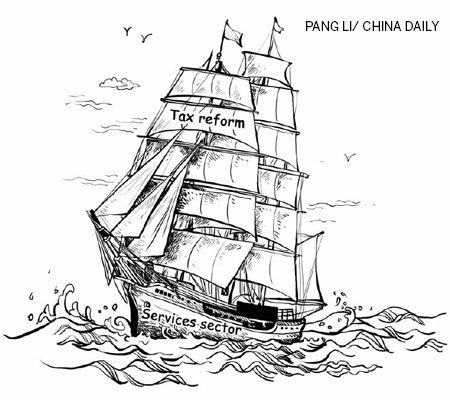
The Chinese government is embarking on an ambitious reform program for its indirect tax system. The objective is to replace the current dual system of indirect taxes - value added tax (VAT) and business tax (BT) - with a single VAT system, which applies to the entire goods and services sector.
The reform will be implemented progressively over a period of time, with BT being replaced by VAT on a sector-by-sector and province-by-province basis. It started in Shanghai on Jan 1, 2012, with the transition to VAT for "modern services" and transportation sectors, before being extended to the rest of the country on Aug 1, 2013.
The first phase of the VAT pilot program has been implemented relatively smoothly, with many businesses reporting overall easing of their tax burden. Since the initial phase of the VAT pilot program has been completed, attention is now turning to the remaining sectors of the economy that are yet to transition to VAT.
VAT (or a similar goods and services tax) now applies to more than 160 countries. International experience shows that the next phases of the VAT pilot program, due to start in 2014, will be far more challenging. In 2014 (and early 2015), it is expected that VAT will replace BT in several critical sectors, including telecommunications, construction and real estate, and financial services and insurance.
For the telecommunications sector, it is widely speculated that an 11 percent VAT rate will apply. This VAT rate contrasts with the 17 percent VAT rate applicable to the sale of mobile telephone equipment (that is, handsets), and the 6 percent VAT rate currently applicable to certain IT and data services. Not surprisingly, complexities can arise in a number of areas - classifying certain telecommunications services and applying the correct VAT rate, determining how VAT should apply to global roaming and other cross-border services, and implementing the golden tax system for such a large and diverse customer base across all provinces of China.
The growth of e-commerce and the increasing delivery of services electronically also pose a challenge for policymakers in ensuring the new system is suitable to withstand modern technological developments.
In the construction and real estate sector, an 11 percent VAT rate is expected to be introduced, to replace the current 3 percent and 5 percent BT rates. Not surprisingly, industry participants want to understand the impact this change will have on their tax burden, given that any VAT on inputs into real estate development, its ongoing operation, and sale or leasing is expected to be creditable for general VAT taxpayers.
Copyright 1995 - . All rights reserved. The content (including but not limited to text, photo, multimedia information, etc) published in this site belongs to China Daily Information Co (CDIC). Without written authorization from CDIC, such content shall not be republished or used in any form. Note: Browsers with 1024*768 or higher resolution are suggested for this site.
License for publishing multimedia online Registration Number: 20100000002731 
