Comments
  Print
Print  Mail
Mail  Large Medium Small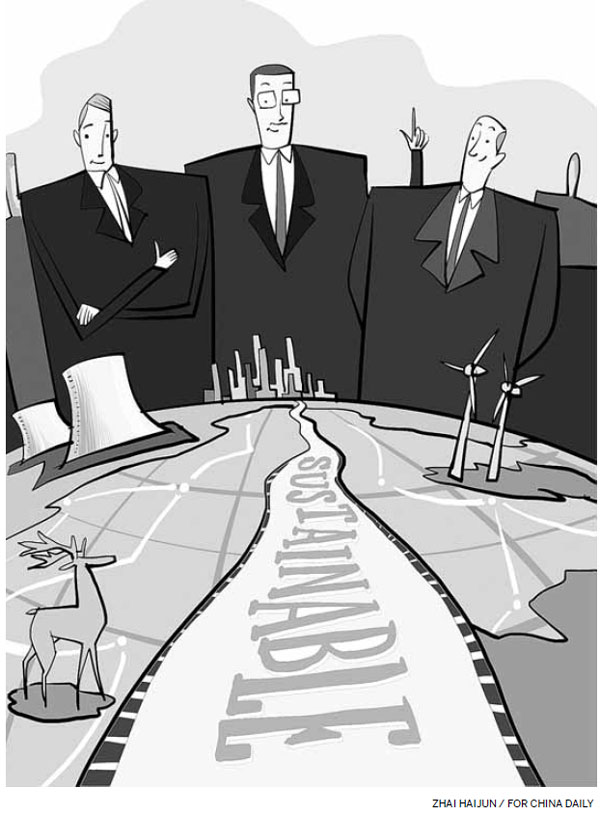
Ground-breaking research gives reasons for concern as well as optimism about the planet
Two reports on how well the world is doing in rising to the challenge of environmental and socially sustainable growth were published recently.
The United Nations Intergovernmental Panel on Climate Change issued its findings on global temperature trends, for the first time in six years. The other report, published every three years, focused on the "corporate temperature", studying the attitudes of more than 1,000 CEOs to sustainability. It is the largest research study of top executives ever conducted on sustainability.
When the UN and Accenture last surveyed CEOs, in 2010, CEOs sent a clear message: Despite the global economic slowdown, business was well placed to lead the world toward sustainable economic growth. They believed that the market would correct for social, economic and, importantly, environmental externalities.
Three years on and CEOs are less confident. An overwhelming majority still see sustainability challenges as important to their companies' futures. However, only a third think business is doing enough to meet the challenge. On the evidence of 2010 you would expect that proportion to have risen.
There is good news, though, in two forms. The first is that CEOs in Asia, and in China in particular (where the views of 42 CEOs of top Chinese companies were studied in depth), see the challenges of sustainability as more urgent than do their European and US counterparts. We call this "the lens of proximity". Chinese CEOs are closer to the challenges of sustainability issues (the trilemma of economic growth, sustainable resource use and environmental protection, complicated by China's new trends of urbanization and more consumer-driven growth). This is making Chinese CEOs more aware of the challenges. Ninety percent of Chinese CEOs think sustainability is a route to competitive advantage, which is nearly 15 percent higher than the figure for European CEOs.
Likewise, although our study shows that CEOs globally are still struggling accurately to measure the value of sustainability initiatives to their business, it seems that Chinese CEOs are having greater success, with more than two-thirds of the ones we studied saying they could accurately measure the value of sustainability to their businesses. The key will be to push this figure toward 100 percent, while the global proportion of CEOs saying they can accurately measure sustainability "in dollars" is falling.
The second piece of good news is that we are seeing an emerging blueprint for successful sustainability strategy in the form of transformational businesses. Our research confirms a tangible link between high-performance companies and successful sustainability strategies.
The report identifies a series of features linking what we call transformational leaders: companies that outperform their peers on sustainability metrics as well as traditional business metrics. To take three traits, transformational CEOs are more likely to see sustainability as an opportunity for growth and innovation, with more than 80 percent of them seeing opportunities to out-compete rivals, reach new markets or develop new business models around a more sustainable performance.
Likewise, these CEOs' companies usually go beyond measuring their emissions to fully quantifying and monitoring the "dollar value" of sustainability to their companies. For example, 81 percent of transformational leaders practice integrated reporting of financial and sustainability metrics.
If I was to add a third reason for optimism it would be this. The number of businesses around the world taking sustainability seriously is rising. The UN Global Compact, which works to convene companies around the world to realize the principles of sustainability, now has more members than ever - more than 10,000 corporate participants. And many of these new companies are in China, participating in the compact's local network.
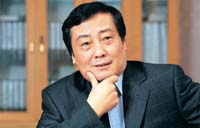
Already bright spots of innovation are apparent across Asia. From investment in clean energy, such as solar power, to innovations in mobile technology to connect rural people, the unique challenges of fast-growing Asian economies are generating unique solutions that can unlock business value while supporting green growth. China's Broad Group, for example, has evolved from being an air conditioning maker to offering complementary services as a building energy service company and manufacturer of sustainable prefabricated buildings. Its comprehensive stance on sustainability stems from the belief of the CEO, Yue Zhang, that sustainability is not only about a product or service, but an approach on how to do end-to-end business.
As Yue Zhang told us, "Sustainability value and business value are completely aligned and, in fact, they are the same thing to me. I consider environmental protection, social values and other sustainability values as having exactly the same impact on my company as cost saving, brand management, risk reduction and business development initiatives."
Starting from equipment innovations focused on energy efficiency goals, to systematically approaching overall building energy management, to ultimately manufacturing sustainable buildings that are also material efficient, recyclable and dust-free, Broad Group demonstrates how rapid urbanization and investment are driving new solutions that can achieve a win-win on business value and sustainability impact.
From a macro level, most experts I met agree that China urgently needs to achieve a new balance between economic growth, resource use and environmental impact. It is a common expectation that the growth of economy and business should not only provide the country with jobs and income at present, but also see more ideas and actions to build the cross-industry capacity for sustainable development in the long run.
For example, China's latest national action plan for air pollution prevention has shown great potential in environment protection-related business sectors, encouraging investors and entrepreneurs to boost innovation and implementation in fields such as clean energy, new material, bio-tech, emission control and waste treatment.
We believe that China is uniquely positioned to turn challenge into opportunity through the transition to a new development model, one in which the country's continued economic prosperity is decoupled from its increasing use of scarce resources and increasing environmental degradation. We call this model the new resource economy. It encompasses all levels of society, from the individual through to enterprises and government. It requires an economy-wide transition in how resources are sourced, consumed and managed.
Enterprises have a very distinct double identity of both resource consumer and product/services provider, so there is a huge amount CEOs can learn from each other on sustainability, in China and beyond. That is why we will be producing more work in the coming months looking at the specific challenges that the new resource economy is presenting to CEOs in China and how they are tackling it. We know that only by learning from each other can we tackle this global challenge locally.
The author is managing director of Accenture's Strategy & Sustainability Services, Asia Pacific. The views do not necessarily reflect those of China Daily.
 Robots kick off football match in Hefei
 Aerobatic team prepare for Aviation Convention
 China Suzhou Electronic Manufacturer Exposition kicks off
 'Squid beauty' and her profitable BBQ store
 A day in the life of a car model
 Vintage cars gather in downtown Beijing
 Asia Bike Trade Show kicks off in Nanjing
 Student makes race car for 4th Formula SAE of China
Copyright 1995 - . All rights reserved. The content (including but not limited to text, photo, multimedia information, etc) published in this site belongs to China Daily Information Co (CDIC). Without written authorization from CDIC, such content shall not be republished or used in any form. Note: Browsers with 1024*768 or higher resolution are suggested for this site.
License for publishing multimedia online Registration Number: 20100000002731