Comments
  Print
Print  Mail
Mail  Large Medium Small
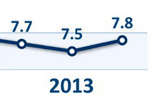
In China, ongoing measures to slow credit growth should put the economy on a lower but more sustainable growth trajectory in line with the government's objectives of about 7.5 percent in 2013. We project growth to further moderate to 7.3 percent in 2014. In light of this benign outlook, the government's focus has appropriately moved away from stimulus toward ensuring a more balanced and less-investment and credit-dependent pattern of growth.
Risks for Asia, however, have shifted to the downside. A further tightening of global funding conditions is possible, and would trigger renewed portfolio outflows, falling asset prices and tighter financial conditions. While trade channels will help over time as the US economy strengthens, the prospects of continued slow growth in advanced economies also presents a risk.
Within the region, the buildup of financial imbalances from loose credit in recent years poses risks to corporate and banking sector balance sheets, including those in China. Also, lack of progress on fiscal and structural reforms in Japan could also have adverse effects on the rest of Asia.
Based on this outlook, Asian policymakers need to strike a balance between supporting demand and ensuring financial stability while accelerating structural reforms. Recent developments also highlight the need for coherent macroeconomic frameworks that are clear, credible and well-communicated.
Current monetary stances, which remain relatively accommodative by historical standards, are appropriate in most countries and provide some insurance against downside risks. The recent tightening of credit conditions in Asia will only gradually dampen the region's strong credit growth and the early signs of financial overheating that had built up in some countries.
In this context, and in light of increased risks of further capital outflows, macro-prudential policies and micro-prudential supervision and regulation will continue to play a role in safeguarding financial stability. In such circumstances, exchange rate flexibility and appropriate use of buffers to smooth volatility should be part of the toolkit.
In China, maintaining recent efforts to rein in the growth of "shadow banking" remains a priority. The curtailing of credit since May is a healthy sign that the government is eschewing quick fixes to artificially boost activity in favor of managing financial risks. Further financial reform, including interest rate liberalization, is needed to safeguard financial stability, improve the allocation of credit and guide the economy to a more sustainable growth path. Some steps have been taken along this route in recent months, and the pace should now be accelerated.
 Robots kick off football match in Hefei
 Aerobatic team prepare for Aviation Convention
 China Suzhou Electronic Manufacturer Exposition kicks off
 'Squid beauty' and her profitable BBQ store
 A day in the life of a car model
 Vintage cars gather in downtown Beijing
 Asia Bike Trade Show kicks off in Nanjing
 Student makes race car for 4th Formula SAE of China
Copyright 1995 - . All rights reserved. The content (including but not limited to text, photo, multimedia information, etc) published in this site belongs to China Daily Information Co (CDIC). Without written authorization from CDIC, such content shall not be republished or used in any form. Note: Browsers with 1024*768 or higher resolution are suggested for this site.
License for publishing multimedia online 0108263 Registration Number: 20100000002731