Comments
  Print
Print  Mail
Mail  Large Medium Small
Region's economies promise to push investment as travel flourishes
As far as the service industry goes, tourism is one of the standout success stories in Asia.
A number of factors have contributed to Asia's rapid growth in tourism: The increased number of Chinese now traveling, Asia's rising wealth and its expanding middle class.
Analysts expect that within the next few years, Asians will comprise two out of five international travelers and that China will overtake the United States to become the world's largest travel and tourism economy by 2023.
Despite the economic slowdown in Europe and the US, the tourism sector in Asia grew by 7 percent last year, the highest of any region in the world.
Throughout the region, new airports, hotels and terminals for cruise liners are being built to cater for the growing demand.
Receipts from tourism last year totalled $323 billion - 30 percent of all international tourism receipts, according to data from the United Nations World Tourism Organization's (UNWTO) World Tourism Barometer.
At the same time, Chinese travelers spent a record $102 billion on international tourism, a 40 percent jump from $73 billion in 2011, UNWTO data show.
Tourism is an example of a flourishing services trade, and "the creme de la creme of services," says Frederic Neumann, HSBC's co-head of economic research for Asia.
"Promoting tourism is a way to bring revenue directly to people who live in some of Asia's more underdeveloped areas, because relatively little migration and upheaval are required (which is often not the case with other industries)."
Forecasts from the World Travel & Tourism Council show a steady increase in tourism's weight over the next few decades. This is not surprising given the strong support the sector has received and will continue to receive in the future.
Neumann says the logic behind promoting and opening up tourism trade should expand to all types of services.
The World Economic Forum estimates the tourism sector in general accounts for around 4.6 percent of growth in the Association for Southeast Asian Nations, which could be as much as 10.9 percent if indirect contributions are included.
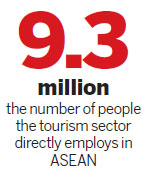
It directly employs 9.3 million people, or 3.2 percent of total employment, and indirectly supports some 25 million jobs.
In a recent analysis, the WEF said the tourism picture was not uniform throughout ASEAN, with some countries doing better than others.
Singapore, for example, draws 20 times more tourists per capita and 30 times more receipts per capita than the ASEAN average.
Malaysia is one of the world's top 10 destinations, with about 25 million visitors per year, while the Philippines, despite its much larger population, attracts much fewer.
The Philippines suffers from a poor international image, mainly caused by lack of infrastructure and security concerns.
Fewer than 6 million people visit the Philippines annually, compared with nearly 9 million visiting Indonesia.
The Philippine government earlier this year announced it would spend $700 million over the next two years upgrading or building new roads connecting some of the country's more attractive tourist spots in a bid to entice more foreign tourists.
In June, the government of Myanmar announced a $500 million "master plan" to increase tourism, while at the same time protecting environmentally important areas and safeguarding ethnic communities.
"This plan outlines a path to welcoming more visitors to Myanmar without threatening our unique cultural heritage or endangering pristine environments," U Htay Aung, Myanmar's minister for hotels and tourism, said at the time.
If Myanmar continues implementing economic, political and social reforms, international visitor arrivals are forecast to rise to as high as 7.5 million in 2020 - a sevenfold increase from current numbers - with corresponding tourism receipts worth around $10 billion.
It has been estimated by the Asian Development Bank that the tourism industry could provide up to 1.4 million jobs in Myanmar by 2020.
"Tourism will be a pillar of Myanmar's economy. It has the potential to create meaningful job opportunities for the country's people, including those living in poor communities," ADB Vice-President Stephen Groff said.
"This plan is a long-term vision. A solid start to ensuring tourism contributes to equitable social and economic development in Myanmar."
Funded by Norway, the plan calls for the building of tourism-related human resources by strengthening the tourism education and training system. It has identified $44.5 million in new opportunities and partnerships aimed at training tourism workers.
 Robots kick off football match in Hefei
 Aerobatic team prepare for Aviation Convention
 China Suzhou Electronic Manufacturer Exposition kicks off
 'Squid beauty' and her profitable BBQ store
 A day in the life of a car model
 Vintage cars gather in downtown Beijing
 Asia Bike Trade Show kicks off in Nanjing
 Student makes race car for 4th Formula SAE of China
Copyright 1995 - . All rights reserved. The content (including but not limited to text, photo, multimedia information, etc) published in this site belongs to China Daily Information Co (CDIC). Without written authorization from CDIC, such content shall not be republished or used in any form. Note: Browsers with 1024*768 or higher resolution are suggested for this site.
License for publishing multimedia online 0108263 Registration Number: 20100000002731