Smart enough for the big city?


Analysts pose the question as urbanization proceeds at rapid rate
|
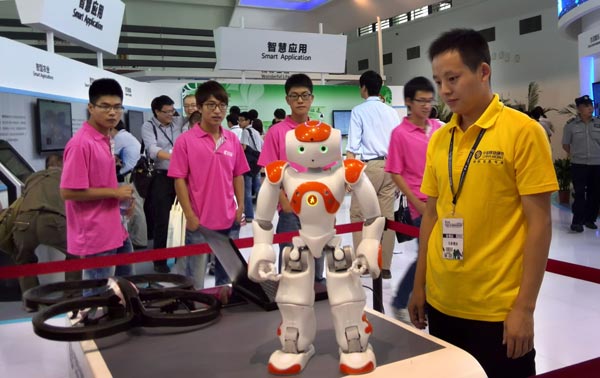 An exhibitor shows a robot at the Smart City Expo China 2013 in Ningbo, Zhejiang province, on Sept 6. Hu Xuejun / For China Daily |
Experts and insiders believe smart city solutions-based information and communication technology can help China meet its urbanization challenges. But the real question is: "How to put that vision into action?"
China is facing a "trilemma" - a difficult choice from three options - on its way toward more urbanization, said Peter Lacy, managing director of Accenture Sustainability Services Asia-Pacific, who sees smart cities as being the solution for the challenges China is facing in terms of managing problems associated with it.
"The increasing population moving from rural areas to cities, the increasing consumption and expectation of citizens as they are getting wealthier and the increasing difficulties in managing the natural resources of energy, water and waste are going to haunt China for the next 30 years," said Lacy.
China is going through an unprecedented urbanization in human history, which has not only transformed the country into the second-largest economy in the world but also attracted more than half of its population to live in cities.
On the one hand a city needs to grow economically. On the other it also needs to improve the quality of its people's lives. Clearly cities are the key to achieve the balance, Lacy said, adding the most critical enabler is going to be smart technology, an idea that makes city management more efficient via collecting and analyzing data.
According to the report Smart 2020, published by Accenture Plc, deploying smart technologies in areas such as electricity grids, transport, logistics, buildings and industrial motors could save 15 percent of global emissions in 2020 and about $900 billion a year by then in energy savings for global industry.
"With the development of technology, it is cheaper and cheaper to put chips everywhere and it is easier and easier to collect data from chips," said George Thomas, a senior executive at IBM, which first developed the concept of smart cities in around 2009.
"Because we are able to collect the data, dig into the data and analyze the data, we are able to answer questions better than before," said Thomas, who is in charge of smart city business in China.
According to him, not only is it possible to predict traffic 60 minutes in advance by analyzing patterns from historical data, people can also ask questions, which they had never thought about asking before.
"This is part of the intelligence and it is really the cool part," Thomas said, adding that from IBM's perspective, smart cities should use an intelligence network to make things better and improve people's lives.
With the ongoing urbanization in China, cities will become bigger and more complicated in terms of management. McKinsey Co estimates that China will have 10 to 12 mega-cities with populations of 15 to 20 million, around which city clusters will form.