


 Comments
  Print
Print  Mail
Mail  Large Medium Small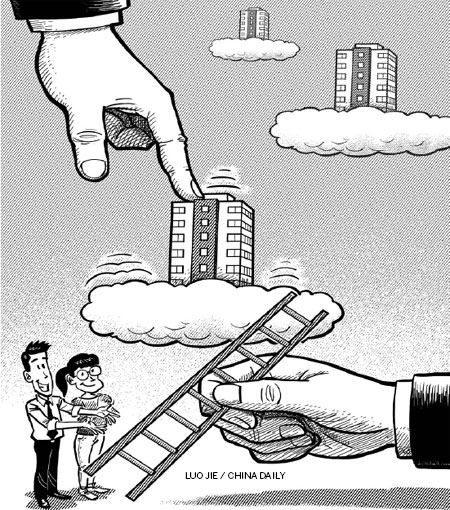
Consider this true story: Four friends used to travel to the outskirts of Beijing almost every weekend to enjoy the relaxing countryside, the fresh air and a barbecue meal on a quaint riverbank. That was their way of overcoming the stress of five days of tiring office work. But of late, one of the friends, Zhou Xin, has dropped out of the trips even though he seemed to enjoy them the most.
The reason: he has bought an apartment and has to save every farthing to pay the monthly installments for his housing loan.
It's not that Zhou does not earn enough. In fact, he earns 10,000 yuan ($1,633) a month, almost double the average salary of 5,223 yuan in Beijing. But then he has to shell out more than 2.5 million yuan for the 36-square-meter space in order to call it home.
Zhou is one of the millions of Chinese suffering the consequences of the high and still rising housing prices. From September 2012 to August 2013, the average real estate price in Beijing increased from 28,602 to 38,212 yuan per square meter. The situation has been the same in many other cities, and there is no sign of any change in the trend.
Some people argue that owning a house is not the be all and end all of life. But in China, like in most other countries, a house is a symbol of respectability and source of security. A 2010 US Department of Commerce report, "Middle class in America", listed homeownership as a prerequisite for a middle-class family. This is true in China as well, especially because tenants in the country lack legal protection and tradition demands that a wage-earner own a house. Little wonder, some economists say a person has to necessarily own a house to be part of the middle class in China.
Like its counterparts in the West, China's middle class is expected to play a key role in boosting economic growth through higher consumption. Several surveys show that middle class consumption contributes about 70 percent to economic growth in many Western countries. The percentage is about 35 in China, with the government expecting the ongoing reform to increase it. A BBC article on June 19 this year even hoped that China's middle class would "spend the world out of recession".
However, unlike in the West, high housing prices are squeezing every penny out of middle-income homebuyers' pockets and thus seriously curbing their capacity and willingness to consume. Many people like Zhou have to first save enough money for the down payment for a house, and after that they have to cut expenses even on some essentials to pay the monthly loan installments.
Another negative impact of high realty prices is the widening social gap. Three years ago, some economists noticed the emergence of a huge interest group benefiting from the massive fund flow into the realty sector. They feared that, in the long run, a small group would form the top of the housing market pyramid, while the majority of the people would find it even more difficult to own a house.
The problem, however, is that even people who do not wish to buy a house - but only rent one -will suffer the consequences of rising high housing prices, because rising prices will force rents to increase and thus raise their living costs. National Bureau of Statistics data show that house rents in Beijing have been increasing for 52 consecutive months, playing a key role in the rising consumer price index.
Some small businesses are already feeling the impact of rising rents. In October 2011, quite a few bookstores in Beijing were forced to close because they could no longer afford to pay high rents.
Since President Xi Jinping talked about the Chinese Dream last year, government departments have been working together to help realize the goal. For the nation as whole, the Chinese Dream means maintaining social stability, ensuring economic growth and common prosperity, and building a secure future. For an ordinary family, however, the key factor in the Chinese Dream is a better life. And keeping housing prices within a reasonable limit is essential to realize the dreams of both the nation and individuals.
High housing prices and rents can hurt economic growth because they prevent the middle class from spending freely. It is thus essential for the government to take measures to keep realty prices and rents in check, because without it neither the national nor the individuals' dream can be fulfilled.
The author is a writer with China Daily.
Copyright 1995 - . All rights reserved. The content (including but not limited to text, photo, multimedia information, etc) published in this site belongs to China Daily Information Co (CDIC). Without written authorization from CDIC, such content shall not be republished or used in any form. Note: Browsers with 1024*768 or higher resolution are suggested for this site.
License for publishing multimedia online Registration Number: 20100000002731 
