Going global? Not so easy


In terms of where Chinese firms like to invest, experts say it depends on what their objectives are.
Anne Marion-Bouchacourt, Group Chief Country Officer for Société Générale China, said emerging markets may have a lower threshold for Chinese companies, but in order to be the best player in the industry, it's necessary for Chinese firms to compete with the best players in mature markets like the United States and the European Union.
|
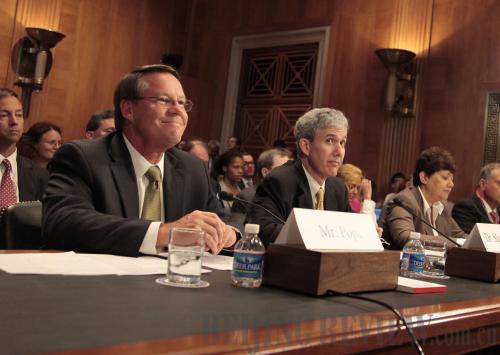 Careful reasoning: Larry Pope (left), CEO of the US pork giant Smithfield Foods Inc, attends a US Congressional hearing on July 10. He explained that Shuanghui's Smithfield purchase will lead to more pork exports from the United States to China.[Photo / bjreview.com.cn]
|
Tough road ahead
Despite soaring outward FDI figures, risks and challenges loom. Li Yizhong, Deputy Director of the Committee for Economic Affairs at the National Committee of the Chinese People's Political Consultative Conference, the country's top political advisory body, said risks might come from social unrest in the invested country, market turbulence and cultural clashes.
Li said the Chinese Government should formulate a national plan to support ambitions for overseas expansion to make it easier for companies to do so. Chinese companies also need to strictly obey laws and regulations in the investment destination countries, especially in terms of intellectual property protection and labor laws, he said. "Having a talent pool specialized in globalization is also a vital factor."
|
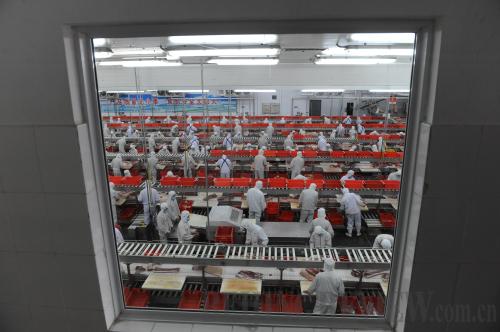 Production power: Workers man a line at Shuanghui International Holdings Ltd in Luohe, Central China's Henan province. Shuanghui, China's largest meat producer, offered to buy US pork giant Smithfield Foods Inc for $7.1 billion, including debt. [Photo / bjreview.com.cn]
|
Li also said companies should always pursue win-win outcomes instead of only considering their own gains. A good example is Geely's purchase of Sweden-based Volvo, he said. "Geely promised not to lay off workers, not to shut down factories and not to move factories from Sweden," said Li. "This ensured a smooth purchase."
Zhao warned of a "glass door" that exists in overseas investment, something that Chinese companies should be cognizant of. "You can see through the 'glass door,' but you can't go through it. You have to understand the hidden rules behind the written ones. That's why Chinese companies should do more research before going global," Zhao said. "You can never be too careful."
But many Chinese companies, especially state-owned enterprises, have had their ambitions for overseas acquisitions thwarted in recent years. State-owned CNOOC failed to buy American petrochemical corporation Unocal for $18.5 billion in 2005, a deal that foundered on US allegations of national security concerns. On October 8, 2012, the US House of Representatives Intelligence Committee issued a report alleging that Huawei and ZTE, two Chinese telecom companies, posed a possible threat to US national security. The committee even urged the US Government and the private sector to boycott the two companies. In 2012, US President Barack Obama blocked a wind farm project by Sany Group, China's largest machinery maker, again on national security grounds. Li attributed those setbacks to mounting protectionism that surfaces when economies are in the doldrums.
Carolyn Ervin, Director for Financial and Enterprise Affairs with the Organization for Economic Cooperation and Development, however, said skepticism toward state-backed companies are not specially targeted at Chinese ones, but state enterprises in general. "A large part of the reason that countries are skeptical against state-owned companies is that they are concerned with their relationship with the government, such as unfair advantages in financing, hiring and resources," she said. To that end, China is working closely with OECD countries to make itself better understood, she said.
Marion-Bouchacourt agreed, saying that integration is the most important factor in overseas expansion. "It's all about building a partnership in a way that is acceptable and understandable."
Li said the Chinese Government should ease away from state-owned enterprises in order to address the concerns of foreign governments and should provide privately owned companies with more access to financing. Finally, if companies were the only decision makers regarding overseas expansion, they would be more rational, said Li.
Learning from failures is also extremely important for Chinese firms with a bent toward global expansion, but most failed cases are not disclosed to the public, said analysts during the 17th CIFIT.
Zhao said there are far more failed cases of overseas acquisitions than successful ones. "People love to flaunt successful cases but avoid talking about failures. This is a very serious problem," he said.
"Chinese companies should carefully study those failed cases and learn from them."