Emerging market prospects


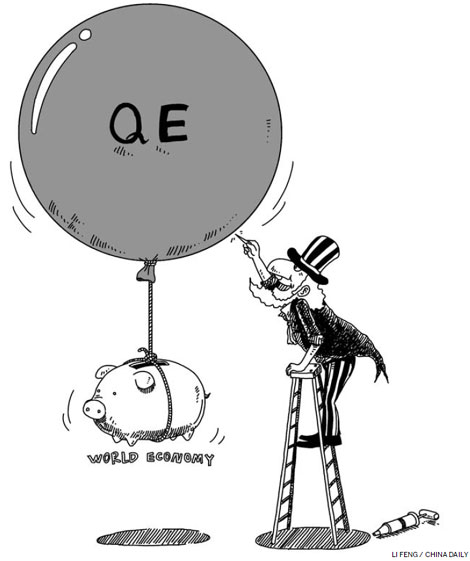
The US Federal Reserve Board seems on course to start reducing the pace of buying bonds. It will eventually raise interest rates, too. After the financial turmoil this prospect has already caused in recent weeks in several emerging markets, notably in Asia, what does it mean for them as they move forward and what should governments do to mitigate the impact?
In recent years, very low interest rates and quantitative easing (QE) in several high-income countries led to large flows of financial capital into emerging economies, including in Asia, fueling credit growth and raising asset prices.
The tapering off of QE and normalization of US monetary policy could lead to a reversal of part of these flows as US yields rise. Indeed, talk by Fed officials about a possible timeline have since June led to higher US bond yields and in recent weeks to a selloff in the financial markets in several emerging economies, especially in Asia.
The financial turbulence notwithstanding, sudden changes in US monetary policy are not on the agenda. The Fed will first reduce the pace of bond buying. The buying would stop later, depending on sufficient growth and unemployment reduction. And the end of QE does not mean the end of easy monetary policy. At Royal Bank of Scotland, we expect the Fed to keep the interest rate at 0-0.25 percent until 2015.
The prospective normalization of the US monetary stance will take place for a good reason: sufficient economic growth and unemployment reduction in the world's largest economy. That is good for the global economy and the export-oriented Asian economies.
Moreover, long-term economic growth prospects in most emerging markets have not changed suddenly. With their current levels of productivity and income much lower than in high-income countries, emerging markets still have a lot of room to grow. Emerging Asia, in particular, has shown it is capable of tapping such long-term growth potential. Thus, emerging markets are likely to remain the key drivers of global growth in the coming decades.
Nonetheless, there are underlying reasons for the recent selloff in emerging markets. Some of the capital inflows were not financing long-term growth. Instead, they were of a short-term nature and not resistant to higher US yields. Financial vulnerabilities built up in countries such as India and Indonesia because they ran up sizeable current account deficits and relied on financial capital inflows to finance them.
Other emerging Asian economies have faced these issues in a less pronounced manner. At the same time, economies with strong current account positions that do not rely on financial capital inflows such as the Chinese mainland, Taiwan and the Republic of Korea have not seen much turbulence.