Tin city explores economic shift


Transformation urged
Peng said his factory employs 600 workers, 80 percent of whom are local residents. Because the profit margin for recycling metals can be as high as 30 percent, the employees earn a higher wage than the average miner or smelting worker. However, Green Novo is just one of a small number of pioneers attempting to change track from the traditional energy-consuming, high-emissions industries.
 |
|
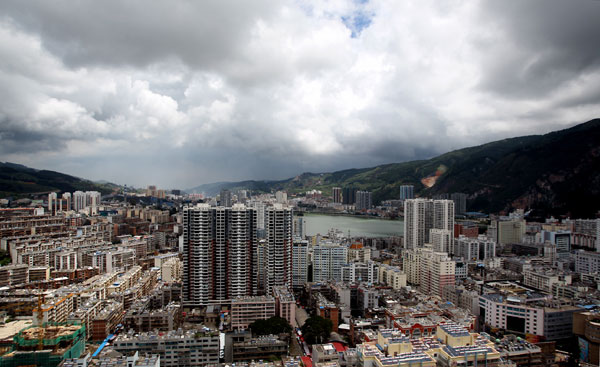
A bird's-eye view of Gejiu city in Yunnan province, which boasts the world's largest deposits of tin. |
Gejiu produced 70,000 tons of tin last year, and 85 percent of the raw materials were imported, according to Wang Yongchang. However, the mining industry has left large areas of land damaged and unproductive because of desertification.
As early as 2007, the massive amount of mining had caused irreparable damage to the land. More than 40 square kilometers, 30 percent of the city's mining area, were used to house mine dumps and slag heaps. That led to problems and accidents; six of the city's townships were hit by flooding and landslides, resulting in 174 casualties and 1,300 dead livestock. Hundreds of houses were wrecked and highways were blocked. One township, Kafang, had to be relocated because of the threat posed by repeated landslides.
This single-industry structure posed a potential threat to Gejiu's economic growth, according to Wang Yongchang. In 2008, tin futures plummeted by almost 30 percent and more than two-thirds of Gejiu's 280 tin producers suspended operations.
At the end of 2007, roughly 30 State-owned enterprises, most of them in the tin mining industry, went bankrupt and 25,000 people lost their jobs.
The layoffs drove some women to turn to prostitution, which rapidly led to a rise in the number of AIDS cases in the city. The abuse of drugs, especially heroin, has also had a huge impact on the local society. Gejiu has more than 5,000 drug addicts, most of whom live in and around the shabby mining sheds, according to a report by Yundi Harm Reduction Network, an NGO that focuses on AIDS prevention and drug control in Yunnan and the Guangxi Zhuang autonomous region.
In the mining areas, women from Hunan and Sichuan provinces provide sexual services, said Dong Jieyu, a retired researcher in women studies from the Yunnan Academy of Social Sciences. "In many cases, the act is committed outside the workers' sheds. In those circumstances it's impossible for the women to use condoms and prevent themselves from becoming infected with the HIV virus."
Dong said many of the sex workers have to continue plying their illegal trade just to support their drug habits.
The mine owners are aware of the consequences of maintaining the old business model. Ma Da, deputy general manager of Zhenxing Group, which has been operating in the area for 30 years, said the mining of tin and other non-ferrous metals consumes too much power and resources and generates a huge amount of waste. He said one-third of the mines in his hometown of Shadian have turned to other business in response to depressed state of the market. "If we continue to mine tin, all that will be left for our children will be barren mountains and rocky land," he said.
"The city must embrace change and shift its economy to a healthier model by prolonging the tin production chain to provide greater added value and making the most of its rich natural resources," said Wang Zhong, the mayor of Gejiu.
Ma said that in developed countries, such as the United States, much of the metal used in industrial processes is recycled, with more than 85 percent of raw tin and lead brought in from overseas. "We will cease our mining activities in five years and my factory will recycle imported non-ferrous metals," he said.