China banking on tax reforms to help transform


|
 |
|
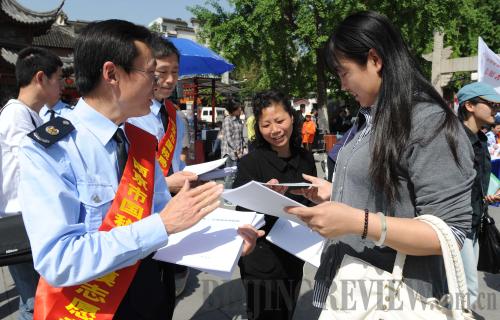
Lots of paper: Tax officials in Nanjing, capital of east China's Jiangsu province, explain the new value-added tax to business owners at a public event. |
New situation
Why is China reforming its tax system now?
Before China can solve the problems harassing its economic and social development, tax reform is needed. For example, to accelerate the transformation of its economic growth model away from a reliance on exports and investment and toward consumption, local governments must have a motive to do so, and reforming the tax system could do the trick. In other words, the present tax system is no longer able to provide enough impetus for economic development.
In recent years, Chinese economic growth has been declining and local governments are racked in financial difficulties. Many make investments on borrowed money to stimulate the economy. But experts say that tax revenue and spending by all levels of governments don't match. Many economists blame the Central Government for collecting too much tax and therefore putting the squeeze on local governments.
If enterprises are burdened by high taxes, the overall economy is impacted. Therefore, the government should support their development by slashing taxes. But there's a bigger problem: The structure and growth model of the Chinese economy is not sustainable. The Central Government expects to change that by reforming its tax system.
Zhang Guangtong, Vice Dean of School of Taxation at Central University of Finance and Economics, says the root cause for local government debt woes is deficit financing, or making investments on borrowed money. Local governments, Zhang suggests, should reign in their spending rather than splurge on projects to boost economic growth and look favorable in the eyes of the Central Government.
Responding to demands by enterprises for tax cuts, the Central Government has launched several measures to reduce the burden. Particularly after the global financial crisis in 2008, the Chinese Government has adopted many measures to alleviate taxes on small and micro enterprises as well as individuals.
The country thus faces a conflict: The government needs a lot of money to develop the economy, but its tax revenue keeps falling. It is a headache for underdeveloped regions. The only solution is to sell land. In some places fiscal revenue from selling land is even higher than tax revenue.
Besides land-sourced fiscal revenue, local governments are also accused of arbitrary charging or borrowing via various local financing platforms. They have borrowed a huge amount of money, and debts are growing.
"The bankruptcy of Detroit is a lesson for the Central Government. During the country's stage of rapid development, serious bubbles emerged in the economy in the form of real estate, surplus capacity and local government debts," Zhang said. "Once any of the bubbles burst, the results would be catastrophic." He adds that tax reform is needed to contain such bubbles.