Banking on learning a few financial lessons


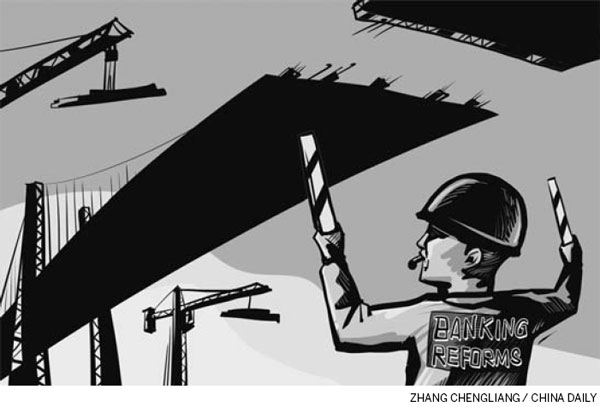
The Chinese banking sector will remember the summer of 2013 as the beginning of a series of painful reforms that heralded a concerted government effort to correct its past mistakes. But in time it might come to collectively acknowledge that the introduction of stricter government policies paved the way to a more sustainable future.
In early June China's banks suffered their worst liquidity crisis in more than a decade. China Everbright Bank was unable to pay back a 6 billion yuan ($979 millions) loan it owed to the Industrial Bank, sparking liquidity concerns across 20 Chinese banks.
This pushed the interbank lending rate past the 10 percent mark, far higher than the generally accepted level of 2.5 percent. The subsequent turmoil in the money market spread to the capital market, causing the yield on a one-year government bill to exceed the yield on the 10-year government bond.
In the face of chaos, the People's Bank of China held firm. The common strategy of China's central bank in such a scenario is to inject additional liquidity to rescue the market. The banking sector, analysts, academics and journalists expected more of the same this time also.
However, the PBOC confounded all expectations. It issued another 2 billion yuan 91-day government note, which withdrew additional capital from the system. The surprise move panicked the markets and the Shanghai stock index plunged 5.4 percent on June 24.
It was a risky test of the resilience of the markets - could they recover without government intervention? The eventual restoration of order proved they could, marking a successful experiment that, crucially, will give the government the confidence to repeat the dose.
Although we have the benefit of hindsight, playing tough was the right call. China's liquidity wobbles stem from the 2008 stimulus plan when the government pumped 4 trillion yuan into the economy to soften the fallout from the global financial crisis. Local governments poured the money into unprofitable infrastructure projects and created an unsustainable property bubble.
Projects were postponed and housing prices stalled. Bank loans could not be paid back. Most of the banks believed the PBOC would soon relax its monetary policy stance in the knowledge that the central bank had always moved to plug any liquidity gaps.
So to pursue higher profits they expanded their loan book aggressively. During the first 10 days in June, total loan growth in China reached 1 trillion yuan. Some banks even lent their full quota for the month in just 10 days, directly contravening the government's efforts to stabilize the money market and bring it in line with long-term aims to rebalance the economy.
By refusing to bail out China Everbright Bank, the PBOC sent a forceful signal to the market that banks should start managing risk carefully and accept responsibility for their own liquidity positions.
If they fall in trouble, the PBOC has made it clear that it is no longer willing to act as their last resort through unconditional bailouts. Instead, the government will rely on the invisible hand of the market and allow the system to gradually restore equilibrium.
Anecdotal evidence suggests banks are responding by implementing their own reforms to rein in irresponsible lending, in some cases even taking extreme action. An employee at one of China's Big Four banks told me they are under great pressure to reject unsuitable loan applications, with the bank in some cases forcing employees to accept personal liability - for example through their pension pots - for loans that turn bad.
The second major summer reform came on July 20 when the PBOC announced that China's banking industry was being given the freedom to set their own lending rates.
Symbolically, it was a highly significant move. It increases competition among China's banks, removing the protective barrier that has long circled China's biggest four State-owned banks and allowing smaller commercial banks to compete on a more level playing field. It was another firm indication of the government's ambitions to further liberalize the Chinese economy and force the Big Four to innovate in the face of stiffer competition. It marks the start of a gradual process that will be accelerated by the next big reform on the horizon: the liberalization of deposit rates, which will help smaller banks attract more customers.
We can expect this policy change to be introduced in about six months to a year, after the government has reviewed the country's overall economic development. And we can also expect that the Chinese government will lift a ban on initial public offerings currently preventing smaller Chinese banks from listing on the stock exchange to raise more funds.
The author is a lecturer in business and finance at the School of Contemporary Chinese Studies, the University of Nottingham. The views do not necessarily reflect those of China Daily.