Bright future for China's supply chain


|
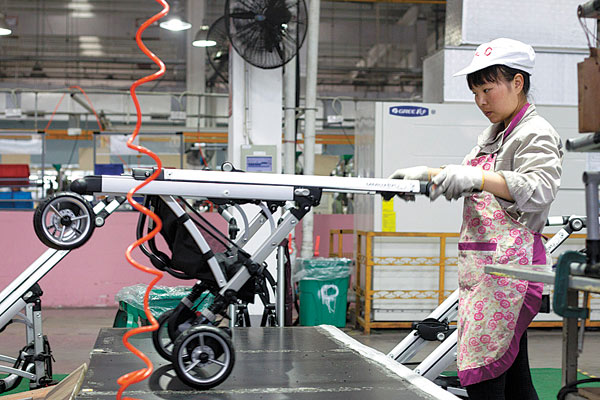 A manufacturing plant of Goodbaby Group Co Ltd in Kunshan, Jiangsu province. Because of the rapidly rising costs and strengthened Chinese currency, the world's second largest economy's position as the global manufacturing powerhouse is being challenged. More and more Chinese contract manufacturers are shifting to enhance their brands, investing more in innovation. [Photo / China Daily]
|
Hit with the double whammy of rising wages and a strong currency, China is no longer the cheapest source for many products, and that's making companies look at shifting production elsewhere, in search of the "next China", according to recent research from the Wharton Business School.
Low-cost labor has allowed China since the mid-1980s to become the pre-eminent manufacturing destination. But now those supply chains are reaching an "inflection point", according to Wharton's Marshall Fisher, UPS professor of operations and information management, and Wharton lecturer Edwin Keh.
Fisher visited China twice in the 1980s to set up business schools through Wharton. He didn't return until 2006 when, among other things, he visited a little-known company called Foxconn. He said he was "shocked by their scale", as well as by all that had happened in China 20 years ago. "It was a wake-up call," he said.
He went back again in 2011, a time of huge labor unrest. A colleague in China who had done his doctoral work under Fisher told him: "You know, we always knew that wages in China were growing steady, at maybe 15 percent a year typically, and we knew that eventually they were going to hit a tipping point. And this is it. This was the sea change."
The end of the competitive strategy that had worked for a quarter of a century was in sight and companies had to figure out what to do. "The idea of change was very vivid that July when I was visiting China and I think it's become more so with passing time," Fisher said.
Keh, who was formerly chief executive officer and senior vice-president of Wal-Mart Global Procurement, said the transformation in Chinese supply chains evolved almost unnoticed over several years. But he has been watching it closely.
"If you look at this on a quarter-by-quarter basis, you may not see it because it's not a singular event," he said. "But certainly it is a trend."
In their research, Fisher and Keh focused on major shifts in Chinese manufacturers.
Chinese companies - such as Foxconn (which makes iPhones) and high-profile apparel provider Luen Thai - are either relocating or expanding their operations away from coastal provinces where wages are high, to less expensive areas such as interior western China or India and Indonesia.
More Chinese contract manufacturers are building their brands, pouring money into research and development and innovation and going after the Chinese domestic market.
As a prime example, Fisher cites the Goodbaby Group Co Ltd, the baby stroller manufacturer that is based in East China's Jiangsu province.
According to China Light Industry Machinery Association, Goodbaby controls 70 percent of the juvenile-products market, with five R&D centers and 4,465 patents.
"What makes Goodbaby striking is that it is unusual and a harbinger of the future - where China is trying to go," said Fisher. "It competes on innovation."
Goodbaby was one of the pleasant surprises that Fisher said they found in their study, "after reading lots of articles in the Western press and even some by Westernized Chinese saying that China will not be innovative, that the educational system is stultifying, it kills creativity, the next Steve Jobs is not going to come from China.
"Here's a guy who was a school teacher, invents a product, starts a whole new company that's the largest most successful stroller manufacturer in the world? It looks a little bit like a Steve Jobs."
Another example of how the supply chains are shifting mentioned in their study is women's shoemaker Daphne International Holdings, which started as a contract manufacturer. Over the years it has built its own brand and a domestic retail network with nearly 6,900 outlets, bringing in 2012 revenues of $1.3 billion and making it the country's top producer of women's footwear.
Keh said that Daphne "serendipitously first created a great manufacturing capability and then a design capability to move further and further up the value chain".
According to the researchers, more and more Chinese suppliers and Western brands are setting their sights on the Chinese domestic market, which is getting more attractive with rising incomes and a burgeoning middle class.
At the same time, Chinese suppliers are investing in lean management techniques to improve productivity and control costs.
The bottom line, Fisher said, is that "China needs to think about what will be the next chapter in its approach to growth".
Fisher said there will be an "exodus from China as a source of supply but it will be a trickle, not a flood, which means for the current strategy, you can imagine an end in sight.
"But inertia's a powerful source and it will continue to be a viable strategy for quite a while."