Home truths for low-cost housing



|
 |
|
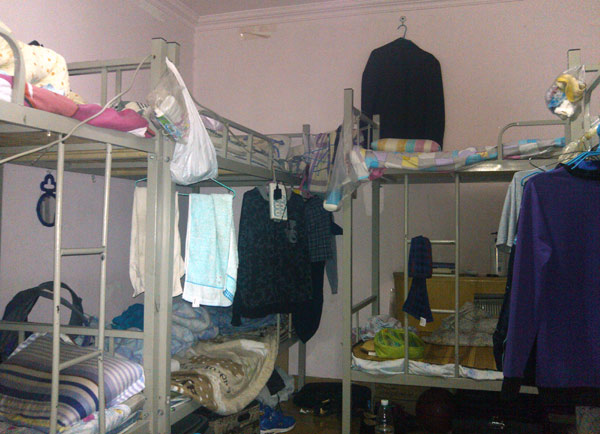 This room in the Dongshengyuan Apartment Building near Beijing's Wudaokou area is a typical shared unit that often houses seven or eight tenants. [Photo / China Daily]
|
Problems rooted in disparity in demand and supply of cheap accommodation
When Ji Xiang leased his small Beijing apartment near the Shuangjing Subway Station in early spring, it was a standard two-bedroom flat with a living room, kitchen and bathroom. Today it is more like a hostel, housing up to 24 tenants.
Bunk beds line the walls in almost every room, each available to rent by the month.
"I'm a fresh graduate myself, so I know how difficult it can be searching for a job and a home," said Ji, who left college this year with "a Web-related degree" and has a full-time job at an Internet cafe.
He said he struck on the idea of investing in a dozen beds after seeing how his relatives had supplemented their incomes by subletting.
In Ji's opinion, he is helping the capital meet the massive demand for cheap accommodation. Only recently did he learn that cramming so many people in one place violates multiple city regulations on housing, and health and safety.
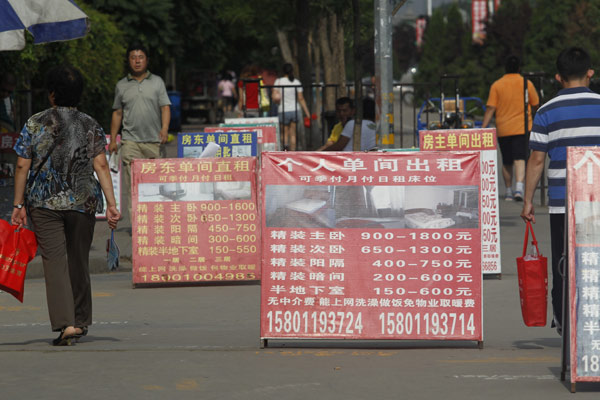
He is not the only one doing it, either. A search for "bed rentals" - the Chinese term for such properties - produces more than 25,000 postings on bj.58.com and about 7,000 more on bj.ganji.com, both major classified advertising websites in Beijing.
Official data support Ji's claim about a disparity in supply and demand. According to the National Bureau of Statistics, the capital has almost 8 million nonnative residents (people without hukou, or permanent residency, who stay six months or more). Yet the municipal public security bureau said in June last year there were only 1.39 million rental properties.
Part of the pressure on the rental market has come from Beijing's measures to cool property prices, introduced in May 2010, which included a ban on non-hukou holders purchasing homes unless they have paid social security or income tax in the capital for at least five consecutive years.
As a result, roughly 81 percent of nonnative residents of Beijing have no option but to rent, estimated Hou Jiawei, director of Population Development Studies Center of Renmin University of China.
Naturally, this has led to a spike in rental prices.
Don't miss:
- Property lending accelerates in H1
- China renews pledge to push property tax expansion
- Property investment risks lower in nation's top cities
- More property developers predict rising profits in H1
- Property next to feel force of tightening
- China less likely to ease property curbs
- Beijing luxury property market rebounds in May