

 Comments
  Print
Print  Mail
Mail  Large Medium Small
"Some of the Chinese SOEs on the list are in industries that don't have complete competition, such as those in the petroleum, electricity, telecommunications and financial sectors," said Wang Zhilei, a research fellow with the Chinese Academy of International Trade and Economic Cooperation, in a research note. "Their financial gains are due to their monopoly status. Although SOEs are an important part of the Chinese economy, further market-oriented reform should be rolled out to add to their competitiveness in the global market."
Wang adds that Chinese SOEs are too reliant on the home market and are ill-prepared to take on the world's top companies.
"Market-oriented reform means SOEs should gain access to resources, such as capital, raw materials and land usage through market competition like any other kind of company. This way, they can learn to use global resources to make money instead of only using China's resources in the Chinese market. If SOEs don't roll out further market-based reform, they can hardly adapt to changes from globalization," Wang said.
China's unbalanced economic structure is evident in the rankings. Chinese firms on the list are largely focused in traditional industries such as steel making, power generation, and energy and chemicals sectors that are struggling with overcapacity. Very few Chinese companies on the list come from high-end manufacturing, the service industry or the technological sector and many of them have reported declining profits or even losses.
Zhuang Ziyin, a professor with the Institute for Advanced Studies at Wuhan University, says China must engineer a transition toward high value-added and technology-intensive industries to avoid a repeat of the woes that have plagued SOEs for years. Zhuang adds that resources and cheap labor are not stable sources of long-term economic growth.
Chinese technology companies, which are under pressure to become the main drivers of growth in the future, are nearly absent from the list, underscoring the urgent need for the country to revamp its economy toward more consumption-based and technology-oriented growth. Only two Chinese technology firms appeared on the Fortune rankings - Lenovo and Huawei - out of 44 high-tech companies in total.
Lenovo rose to 329th from 370th a year ago, but remains far behind Hewlett-Packard, the world's largest PC manufacturer, and technology heavyweights Apple and Samsung Electronics. Telecoms equipment maker Huawei jumped to 315th from 351st.
High-leverage ratio is also a source of concern for Chinese companies. The average leverage ratio, the debt-to-equity ratio, for non-financial Chinese companies on the list came in at 4.42, much higher than the 2.79 of US companies, a sign that Chinese companies are relying too heavily on borrowed money for business expansion.
"After the financial crisis, the United States has been trying to de-leverage its economy while Chinese mainland companies still have a high leverage ratio," said Zhou.
"The recent cash crunch showed the resolve of policymakers to de-leverage the economy, but it's going to be a tough road ahead for Chinese companies."
 Models at Ford pavilion at Chengdu Motor Show
 Brilliant future expected for Chinese cinema: interview
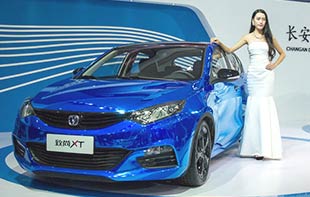 Chang'an launches Eado XT at Chengdu Motor Show
 Hainan Airlines makes maiden flight to Chicago
 Highlights of 2013 Chengdu Motor Show
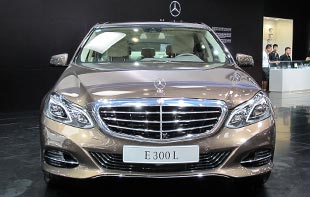 New Mercedes E-Class China debut at Chengdu Motor Show
 'Jurassic Park 3D' remains atop Chinese box office
 Beauty reveals secrets of fashion consultant
Copyright 1995 - . All rights reserved. The content (including but not limited to text, photo, multimedia information, etc) published in this site belongs to China Daily Information Co (CDIC). Without written authorization from CDIC, such content shall not be republished or used in any form. Note: Browsers with 1024*768 or higher resolution are suggested for this site.
License for publishing multimedia online 0108263 Registration Number: 20100000002731