Reforming Rail Freight


 |
|
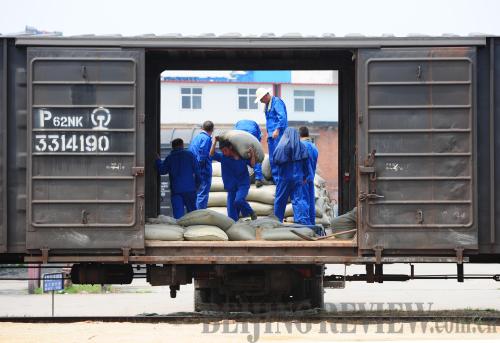
Workers load a freight carriage at the Xinyang Railway Station in Henan province on June 21, soon after rail freight service reforms kicked off (Photo / beijingreview.com.cn) |
Freight Train No 82410 from Beijing to Southwest China's Chengdu departed from Dahongmen Station at 4 pm on June 26. The departure was a special one because it was the first container train of the Beijing Railway Bureau to depart following market-oriented reforms of the rail freight industry that began on June 15. Before that there was no direct freight train between the two cities.
Yang Chunlei, deputy director of the Beijing Railway Bureau Freight Center, said the direct container train to Chengdu is a new freight product offered by the bureau after gathering opinions from customers. Some other changes include adding more freight carriages to match demand and a quicker processing of goods.
The rail freight industry is one of the last few monopoly industries in China. According to the China Railway Corp, reforms of China's rail transport industry will begin with freight. The company says the aim of freight reform is to make the industry more market-oriented and efficient, in a bid to establish a "door-to-door" modern logistics network.
Reform of the sector is the first such reform launched by the China Railway, which was founded in March. Zhao Jian, a professor with the School of Economics and Management at Beijing Jiaotong University, thinks changes are significant to the company's move toward full market-oriented reform.
Wu Yanxia, a sales manager at Beijing Hongsheng Shunda Transport Co, comes to the Dahongmen Station of Beijing Railway Bureau Freight Center almost every day.
"Recently we have gone through fewer procedures to deliver goods, and the railway bureau will also increase carriages whenever necessary upon customers' demand and freight volume," she said.
Wu says she previously had to go through a number of procedures at different counters to clear her goods and get them loaded onto the carriages, but now she gets one-stop service to process her goods at a single counter. More importantly, the minimum freight requirement of 60 tons has been eliminated, a rule that had slowed the transport of goods.
Yang adds that goods no longer have to be processed in person—registration by phone or online is now allowed, creating more flexibility and convenience.
A China Railway press release states that it wants to create a system that is more transparent, especially where pricing is concerned. Cargo owners have long complained of a confusing and unpredictable pricing regime.
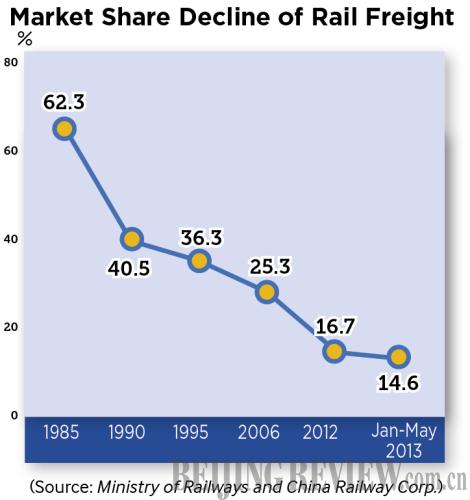
A crucial step
Zhao says that before the reform measures, freight transport was little concerned with the needs of cargo owners. The changes now shift the industry toward a more market-oriented bent, one that saves on energy and better protects the environment.
Before the Ministry of Railways was reshuffled to create the China Railway, customers had repeatedly criticized the old model of railway freight transport. Efficiency was low and customers had to deal with a lengthy procedure to process and load their goods.
"Therefore advancing reform of railway freight transport is crucial to accelerate the development of the railway industry, and it is also an urgent need to raise the economic returns of the railway industry," Zhao said.
He thinks the newly established China Railway has made reforms a top priority. The groundbreaking reforms will allow for larger transport volume, low prices and all-weather services so as to transform the China Railway into a modern enterprise through market competition.
A report by the former Ministry of Railways in July 2012 stated that China's railway freight transport focused little on providing customer service. Under such a management model, marketing plans cannot be formulated in accordance with customer demand.