It's time the US accepted reality


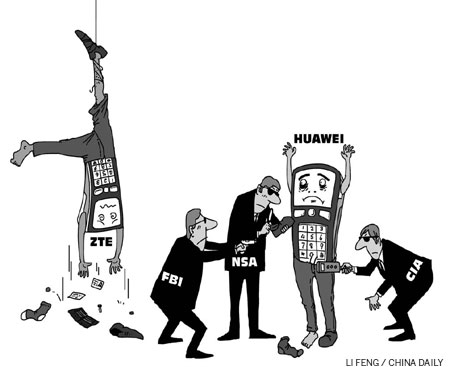
The dust appears to have settled on the spying accusations leveled at Chinese companies Huawei and ZTE by the US government. Espionage, however, remains very much front-page news with Edward Snowden, former CIA agent and US National Security Agency contractor, leaking highly controversial documents to the international media.
Essentially, Snowden has blown the cover of a project named Prism, which allows the US government to spy on Internet activities around the world. This appears to be a different espionage story from that of Huawei and ZTE, but the two are related. In fact, it may well be that they are part of the same story, which has little to do with US national security and prevention of terrorism, and everything to do with the inevitable decline of the US as an economic superpower.
According to the documents Snowden has leaked, the NSA has been collecting astronomical amounts of information from ordinary citizens' online activities with the aid of American IT giants such as Google, Yahoo, Facebook and Apple over the past six years. Files leaked by Snowden reveal that almost 3 billion pieces of information from around the world were collected through project Prism in only 30 days ending in March this year.
What is really behind such covert, intrusive activity on such a massive scale? Of course, the US government has been quick to downplay the scope of project Prism, while attempting to steer the media frenzy toward security and terrorism issues.
But terrorism no longer poses as serious a threat to US national security as it did a decade or so ago. Stories of a specific threat to US national security have long since disappeared from international newswires. So what the US government finds really alarming is the continued weakening of its economy in contrast to the growing international presence and power of China. Noticeably, this is not about political power; it is about the global reach and hold of corporations.
Huawei and ZTE are two examples of Chinese companies' success in the international market, especially in the US. And the US government is not the only one to find this unnerving. American corporate giants such as Apple, Yahoo and Google appear intimidated, too, fearing an end to their dominance. It is in this context that the groundless spying accusations against Huawei and ZTE should be seen.
Sadly, more groundless and disturbing allegations have been made recently. For instance, Snowden has been accused of being a spy working for China. Even the fact that Snowden has left Hong Kong and that his whereabouts are not known is not enough for China-baiters to see reason. If, and it is a rather big "if", Snowden had really been spying for China, he would not have revealed his identity after landing in Hong Kong.
In a nutshell, American companies are working with the US government to stifle the threat of competition from China and other countries. This should explain Washington's need for Prism-like projects, about which a great deal may never be known.
Such a confrontational approach may have worked in the days of the Cold War with the former Soviet bloc. But with this approach US government will find few friends in today's more open and informed international community.
In fact, China's approach offers the US government and corporate giants a better way forward. Patient, engaging relationship building, a key Confucian value, which is still part of Chinese society and businesses, is the path for all to follow.
The US' days as the world's sole superpower are numbered. So it's time it changed its bellicose, bombastic nature of conducting business and accepted the inevitability that comes with the changing times.
The author is a visiting professor at the University of International Business and Economics, and a researcher at Nottingham University's School of Contemporary Chinese Studies.
(China Daily 06/26/2013 page9)