Comments
  Print
Print  Mail
Mail  Large Medium Small
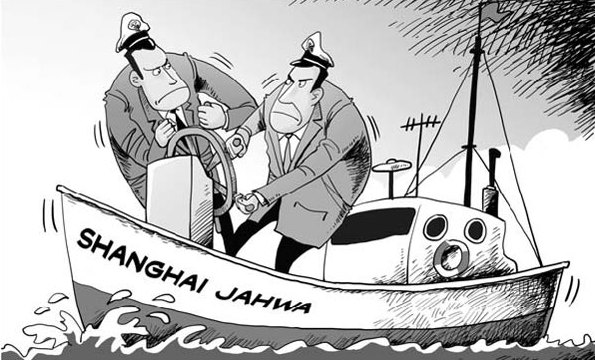
How much is an apology worth? Ge Wenyao, chairman of Shanghai Jahwa United Co, just paid more than 300 million yuan ($50 million) to make one.
It was an expensive lesson for not only Shanghai Jahwa United, a leading Chinese personal care product maker listed on the Shanghai Stock Exchange. It was also a lesson for all who have an interest or are keen to take an interest in the Chinese capital market. The market is still digesting the lesson.
Shanghai-based Jahwa United, one of the leading Chinese companies in the industry, was in trouble when Ge was dismissed on May 11 by China Ping An Trust & Investment Co, affiliated to Ping An Insurance (Group) Co, which owns 20 percent of Jahwa United's stock equity. Ge responded to his sacking on May 13 by openly criticizing Ping An in a personal blog for obstructing his ambitions to develop the company.
On his personal Weibo, the Chinese version of Twitter, Ge complained about Ping An's shortsightedness, saying it broke its promise not to interfere with the management when it bought Jahwa United's shares.
In response, Ping An forced Ge to step down as chairman and chief executive officer of Shanghai Jahwa (Group) Co, of which Ping An owned 100 percent of the equity, for alleged misuse of the company's capital, claiming it had received staff reports since March that Jahwa management was keeping some off-the-book accounts and misusing funds. Shanghai Jahwa (Group) Co is the parent company of the listed Shanghai Jahwa United, where Ge is also chairman.
On May 13, two days after Ping An's announcement was made, Jahwa United's share tumbled 8 percent on the Shanghai Stock Exchange before its trading was suspended the following day.
A total of 4.89 billion yuan in Jahwa United's market capitalization was lost as a result of the fight between the majority shareholder and the chief executive. Other shareholders raised an outcry.
Many shareholders seemed to take the side of Ge because he had guided the company's past growth in competition with global brands and, as a result, had earned a reputation of being a capable businessman.
They criticized Ping An for being brash in its sudden decision and being arrogant toward shareholders' interests.
At the moment, no one knows what the precise consequences are of a fight between a strong-willed chairman and a majority shareholder backed by a major financial house in China, particularly one easily irritated by anyone who dares to show less than total respect for its power.
But many argue there is no need to worry. A capital market with Chinese characteristics has a mechanism to prevent a clash of titans. And they add the government is not afraid of being interventionist.
The State-owned Assets Supervision and Administration Commission of Shanghai municipal government (Shanghai SASAC), which used to own Shanghai Jahwa Group before it transferred its entire holding to Ping An in 2011, stepped in.
"Shanghai SASAC has told me to keep silent," Ge told the Guangzhou-based Time Weekly on May 14. The newspaper also cited an anonymous insider saying that Ge had been seeking the help of Shanghai SASAC since the conflict flared up. However, because Ge had used harsh words against the commission on several occasions, leaders of the asset management authority were not inclined to treat him too kindly.
"Shanghai SASAC asked Ge to keep a low profile and the local media not to sensationalize the news," said the insider. Consequently, Ge, who used Weibo to broadcast his opinions, has stopped posting messages on his account since Shanghai SASAC talked to him.
"It is the last resort to get Shanghai SASAC involved," said a person who has been following the commission's response. "Because Ge holds little of Jahwa United's stocks, he has no say in front of major shareholders. The only things he could count on are the promises made by Ping An at the point of purchase and the fact that the Shanghai government does not want to see Jahwa fail."
On May 16, Jahwa United held a shareholders' meeting to put an end to the dispute. At the meeting, Ge first apologized for mishandling the relation with Ping An and causing losses to shareholders. He then showed a willingness to cooperate with Ping An for the well-being of Jahwa United. "The brand is the most important thing. Anything else does not make much difference to me," he said.
A representative of Ping An said at the meeting that they shared a common goal of turning Jahwa United into a better company for all shareholders and would not waver from its current strategy. The dispute ended in reconciliation. Ge will no longer work as chairman and CEO for Shanghai Jahwa Group, the parent company, but has retained his chairman position at Shanghai Jahwa United, the listed subsidiary.
The reconciliation pushed Jahwa United's stock up by 3.32 percent to 65.08 yuan by the end of trading on May 16, adding a total of 376 million yuan to its value.
However, should a government agency that formerly owned a company's equity step in to mediate over internal strife? What right does the government have to do so? Opinions are divided.
 HK's new cruise terminal receives luxury liner
 Future points to carbon trading
 Seafood businesses flounder amid spending cut
 Equities slump amid slow-growth estimates
 Auto show opens with much fanfare in Xi'an
 Sunnylands summit fuels Chinese tourism interest
 'Palace on wheels' on sale for $3.13m in Dubai
 Fortune smiles on Chengdu as forum concludes
Copyright 1995 - . All rights reserved. The content (including but not limited to text, photo, multimedia information, etc) published in this site belongs to China Daily Information Co (CDIC). Without written authorization from CDIC, such content shall not be republished or used in any form. Note: Browsers with 1024*768 or higher resolution are suggested for this site.
License for publishing multimedia online 0108263 Registration Number: 20100000002731