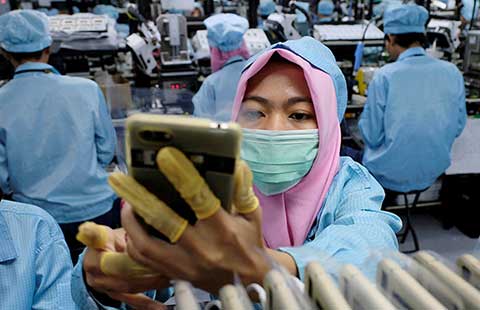
Dongguan 'remains processing trade hub'


|
 |
Local companies under pressure from rising yuan, upgrading costs
Local government officials have insisted that Dongguan remains a top destination for processing trade businesses, despite recent closures in the city being blamed on the continued strength of the yuan.
He Yu, Dongguan's vice-mayor, acknowledged that some processing trade businesses had closed since the end of last year, but he said those were due to what he called a "provincial-wide industrial reshuffle", which will not affect the city's overall economy.
A report in China Times last week claimed that a growing number of processing trade enterprises in Dongguan and nearby Shenzhen - both in Guangdong province - especially those funded by Hong Kong and Taiwan businesspeople, have been forced to close because of various market factors, particularly the rising value of the yuan.
According to the China Foreign Exchange Trade System - also known as the National Interbank Funding Center - the yuan advanced 87 basis points to 6.1911 against the dollar on Tuesday, the highest level since China's foreign exchange reform in 2005.
On China's foreign exchange spot market, the yuan is allowed to rise or fall by 1 percent from the central parity rate each trading day.
Early on Monday, the yuan weakened 1 basis point to 6.1998 against the dollar, according to the exchange trade system.
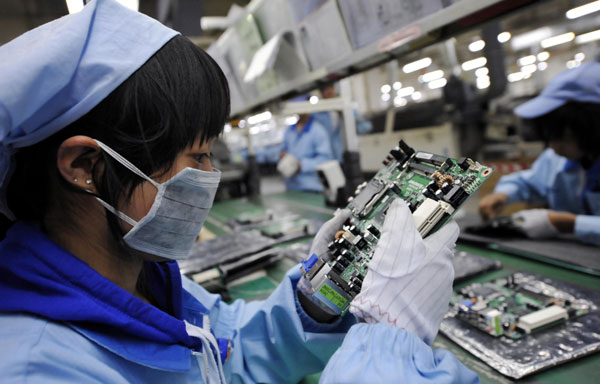
Dongguan, in the heart of the Pearl River Delta, is considered one of the world's top manufacturing hubs.
Officials said it is home to more than 330,000 enterprises, most of which are engaged in the processing trade, or the business of importing and assembling materials, parts and components.
"Only 800 enterprises closed last year. It is rational, given that we are making efforts to help upgrade this traditional industry," He told China Daily.
Since 2008, more than 4,000 traditional processing trade enterprises in Dongguan have upgraded their operations, without having to close, sources with the local government said.
Alongside some closures, He said there have also been a rising number of new businesses being opened in the city, including more than 1,000 in the city's Dalang township.

According to industrial upgrading guidelines, issued by the provincial government in 2008, traditional processing trade industries were encouraged to move from the Pearl River Delta region by the end of 2012 to eastern, western and northern areas of Guangdong, where labor and production costs are comparatively lower.
High-end and financial service businesses, meanwhile, were encouraged to move into the Pearl River Delta region.
The guidelines also encouraged processing trade business - which used to depend on exports for growth - to focus on the domestic market.
And to promote the industry, local officials launched the annual China Processing Trade Products Fair, being held this year from June 19 to 21.
"The fair aims to help traditional processing trade enterprises turn their attention on the domestic market," He said.
Processing trade industries have thrived in the Pearl River Delta region since the 1980s, when many Hong Kong and Taiwan businesses moved there to trade with overseas clients.
However, the appreciation of the yuan and increased production and labor costs have made the industry upgrades being encouraged by local authorities difficult for some businesses.
"A growing number of smaller-scale processing trade enterprises have closed operations or transferred to other Asian regions after they found it difficult to make profits in the domestic market," said Huang Guoyi, assistant manager of a chamber of commerce in the Songgang township in Shenzhen.
Liu Chengming, the owner of a shoe manufacturing enterprise in Huizhou, which neighbors Dongguan and Shenzhen, said the rise of the yuan had narrowed his profit margins over the past few years.
"Overseas clients have demanded a lower price as the yuan appreciated," Liu told China Daily.
His company moved from Dongguan in August last year to Huizhou, where labor costs are lower.