Churning revenue out of VAT


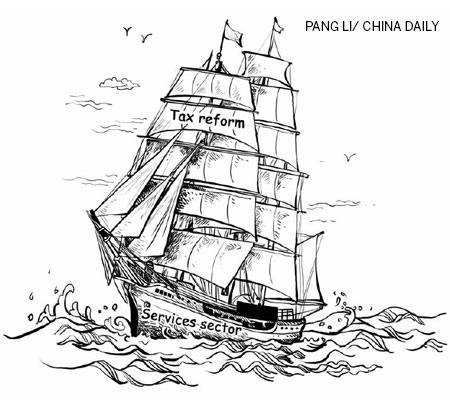
China's value-added tax pilot program, applicable to the transportation and modern services industries, has started expanding nationwide. This major expansion represents the completion of the first phase of a broader reform process to ultimately replace business tax with a modern VAT across China. This important development, in turn, will align the indirect tax system applicable to the goods sector with that of the services sector, thereby achieving efficiency right across the economy.
But how will China's VAT system compare with indirect tax systems used globally when the reforms are complete?
Internationally, modern indirect taxes, such as VAT, are now applied in more than 150 countries, including 33 of the 34 member countries of the Organization for Economic Cooperation and Development. The United States is the lone OECD member not to apply them and continues with its sub-national sales tax structure more suited to a mid-20th century economy. China's general VAT rate of 17 percent, together with its reduced rates of 6 percent for the modern services industry, and 11 percent for the transportation sector compare favourably with the average rate of 19 percent in OECD member countries.
Consumption taxes such as VAT now account for 31 percent of all revenue collected by governments across OECD member countries. The reliance of governments on revenue from taxes like VAT is increasing, as other more traditional forms of tax revenue, such as corporate taxes become more mobile and more susceptible to fluctuations based on prevailing economic conditions.
Businesses in many countries assume that the recently announced tax reforms by their governments are aimed at increasing tax revenues. But the reforms in China are different, because they involve a shift from a business tax system, which causes taxes to cascade down the supply chain, to a modern VAT system that exempts business inputs from tax. The State Council estimates that the reforms will reduce the tax burden nationwide by about 120 billion yuan ($19.50 billion) in 2013.
In practical terms, it means that a consulting business in Qingdao, Shandong province, for example, will be eligible to claim VAT credit for the purchase of its IT equipment; the effective cost of a new vehicle bought by a Beijing transportation company will drop by 17 percent; a research and development facility established by a Shanghai pharmaceutical company can claim refund of VAT where the rate of service is zero; a software developer in Chengdu, Sichuan province, can compete more effectively on the world stage by licensing their products free of VAT; and a manufacturer in Guangzhou, Guangdong province, will no longer have to bear a real indirect tax burden for the transportation and services it requires to get its products to the market.
In essence, these changes should facilitate the growth and development of the service sector for achieving the goals set out in the 12th Five-Year Plan (2011-15) while, at the same time, providing a welcome reduction in the costs of China's dominant manufacturing sector.
Similar reforms are being worked out in countries like India and Malaysia. Although many governments are closely studying such reforms, the speed at which China has implemented them has amazed countries around the world. This is due, in no small part, to the enormous efforts of the Ministry of Finance and the State Administration of Taxation.
Experience shows that the hurdles in the short-term transitional period are the most difficult to overcome. This is the period when businesses need to assess the impact of tax changes on pricing, resolve technical issues with their tax officials, implement IT system changes and update invoicing procedures. However, in the longer term the broader efficiency gains of the reforms will inevitably produce lasting benefits.
None of this should suggest that the reform process in China is complete. Industries such as telecommunications, construction and real estate, and financial services and insurance are likely to transition from business tax to VAT progressively in 2013 and 2014.
The shift to a modern VAT system must be seen as an evolutionary process, as is evident in the growth of sectors such as e-commerce, which was unheard of when VAT was introduced in China in 1994. China's modern VAT system, however, is well positioned to meet these changes.
The expansion of the first phase of the VAT pilot program across the country is a critical milestone in the modernization of China's indirect tax system. The early signs point toward the adoption of a system that represents the world's best practices, though much work remains to be done.
Tim Gillis is global leader of KPMG's Indirect Taxes, and Lachlan Wolfers is partner of KPMG China.