Chinese firms 'create many jobs' in Germany, says ambassador


With China's investment in Germany increasing at a rapid pace in recent years, the nation's top diplomat in the European country sought to assure that this would benefit rather than harm local economic and employment prospects.
Shi Mingde, Chinese ambassador to Germany, said China is quickly sharpening its industrial competitiveness and rapidly narrowing the gap with its counterparts in Germany, the world's strongest manufacturer.
The past few years saw a growing number of Chinese investment deals in Germany through mergers and acquisitions.
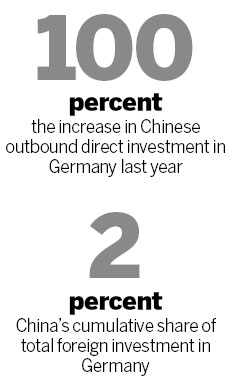
China's outbound direct investment in Germany increased by more than 100 percent last year, overtaking Germany's annual investment in China for the first time. Germany was the destination for more than 50 percent of China's ODI in Europe in 2012.
Last year, Changsha-based Sany Heavy Industry Co Ltd announced the purchase of German concrete pump maker Putzmeister for 360 million euros ($474 million), the largest direct investment by a Chinese company in Germany.
In August 2012, Chinese industrial manufacturer Shandong Heavy Industry Group purchased a 25 percent stake in Germany's Kion Group, the world's second-largest forklift maker, for 467 million euros.
China's businesses accelerated the pace of their entry into Europe over the past two years, and in Germany in particular, Shi told China Daily.
"It was not an accidental case, and the growth could be sustained as Europe is in need of money and its debt problems remain unresolved," Shi said.
Wang Weidong, China's commercial consul-general in Frankfurt, said that "China's purchases in Germany are expected to grow in the coming years", and the high-end manufacturing and processing and high-tech and machinery sectors would be targeted.
Wu Hailong, Chinese ambassador to the European Union, said that China and the region would start negotiations on a bilateral investment treaty in the coming months.
But while Chinese purchases pick up, Germany has concerns about China's growing investment, complaining that the nation's ambitious deals hurt local employment, said Shi.
"But Chinese companies in Germany create many jobs, paying a large amount of taxes and stimulating the local economy," he added.
More than that, the rapid growth is just a small part of China's investment in Germany, he said.
China's cumulative investment in Germany accounts for 2 percent of total foreign direct investment in the country and is 10 percent of Germany's total investment in China.
"China cannot pose any sort of threat to Germany," Shi said.
Wang said the German government and enterprises have misunderstandings about Chinese investment, fearing that Chinese companies would fire local employees and undermine the nation's traditional management and business models.
Facts have shown that Chinese companies help their German counterparts expand in Asia and create local employment, Wang said.
As China pledges to sharpen its innovative capabilities, improving the quality of its technology and adding value to the manufacturing sector, Germany could provide Chinese companies with access to technology, distribution channels and branding.
"China could sharpen its industrial competitiveness through mergers and acquisitions in Germany, as a slew of small and medium-sized enterprises suffering financial problems own quality goods and technologies," Shi said.
In 2009, China surpassed Germany as the world's largest exporter, but the nation is still challenged for not being strong in manufacturing.
"It's true that made-in-China lags behind made-in-Germany, but the two complement each other," said Shi.
And as the nation is committed to improving the quality of its manufacturing sector, "China enjoys advantages in making low- and medium-end goods, and we are becoming a strong competitor with Germany in terms of some medium-range goods, especially in the telecoms sector," said Shi.
"We have the capacity to catch up with them, and it won't take a long time," he said.