Digging deeper


|
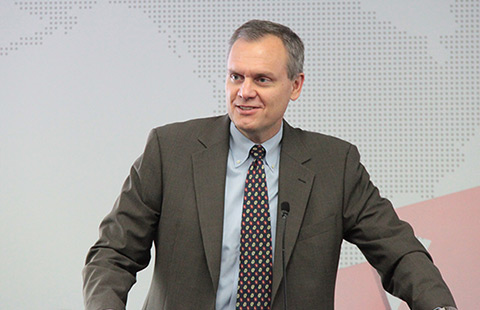
 Clockwise from top: David Humphreys, principal at DaiEcon Advisors; Huang Haiwei, associate director of The Beijing Axis; Michael Power, investment strategist at Investec Asset Management; Martyn Davies, chief executive of Frontier Advisory. [Photo / China Daily] |
The significance of China at this year's Indaba was further reinforced by the first-ever official Chinese delegation led by Wang Min, China's vice-minister of land and resources.
He told the conference the number of Chinese mining investment projects in Africa accounted for 34 percent of its global total and 22 percent by value.
"Mining is a traditional area for Chinese investment in Africa. Chinese mining companies have made progress in their mining investment projects in South Africa, Zambia, Angola, the DRC, Sudan and other countries, promoting local employment and economic development."
He said there was a natural synergy between resource-rich countries in Africa and countries such as China that had huge markets.
"China and Africa need to deepen practical cooperation in the mining sector. We need to strongly implement the agreements on mineral exploitation, investment and mineral commodities
Chinese resources companies such as China Nonferrous Metal Mining (Group), CITIC Group Corporation, China National Petroleum Corporation, China Railway Resources Group and Beijing Haohua Energy Resources Company have been dominant players in Africa over the past decade or more. Power at Investec says that in the first half of the last decade it was Chinese companies that were calling all the shots in Africa. "The Chinese came in and pretty much did it 100 percent the way they wanted to do it. As a result, in this first generation of engagement they might have been a little brusque about local sensibilities," he says. More recently, China has faced increasing competition in Africa from other emerging market players in the resources sector. PPT Exploration and Production, the Thai state-owned group, acquired major oil fields in Mozambique with its acquisition of the Irish company Cove Energy last year. This came not long after Pertamina, the Indonesian state-owned energy company, paid a record price for an Angolan oil block, beating off competition from its Chinese rival Sinopec. "These investments show that China is no longer the only kid on the block. It might still be the main kid on the block, but it is certainly not the only one," Power adds. "You not only have the Indonesians and the Thais but the Brazilians have also come in. Even the copper belt in Zambia is now more Indian than it is Chinese." The Chinese attendance at Indaba proved that Chinese companies are still very much part of a major presence in the market. Huang Haiwei, associate director of The Beijing Axis, a consultancy that provides strategic advice to Chinese companies in the resources sector, says Chinese companies are still very much active in the market. "People who want commodities can't really go window shopping. They can't be like all those people you see in the streets walking past department stores with nothing to do. They have a responsibility to act. The market is very transactional. They need commodities to turn into cash," he says. Huang says most of his clients - both state-owned enterprises and private companies - are looking to take complete ownership of existing facilities or enter into strategic equity partnerships rather than develop greenfield sites. A typical investment would be $100 million. "It is a very capital-intensive business. The investors are not looking for short-term cash-generating projects but are looking to get cash flow over five, six or nine years," he says. Duncan Clarke, an oil industry strategist and author of Africa: Crude Continent: the Struggle for Africa's Oil Prize, says China's role in the resources sector in Africa is often exaggerated. "There are probably between 700 and 800 companies in the oil and gas sector in Africa, and among these are just four or five Chinese state-owned companies. I know that these companies are large, with an increasingly growing portfolio in exploration and development but they are still among many other players." Don't miss 
- Deputy appeals for greener coal mining policies
- China to halt approvals for small coal mines
- Border outpost turned into mining boomtown
- China's Hanlong to obtain major African iron mine
- China-led group agrees to mine deal
- Competition, labor costs hurt African profits
- Xi pledges continued support for Africa