The volume of fast-moving consumer goods products bought per household expanded 3.1 percent in the country's provincial capitals, 4.8 percent in prefecture-level cities and 5.4 percent in county-level cities. The demand in the lower-tier cities remained buoyant, according to Kantar Worldpanel.
"The country's 250 second-tier cities will be the main drivers in fur consumption as a result of the urbanization," said Mark Oaten, chief executive officer of the International Fur Trade Federation.
China has become the world's largest fur production and consumption country since 2011. The country's fur trade accounts for a quarter of the global total. IFTF believes that the market will be robust in the next decade as more and more people and money move into the cities.
|
 |
Besides the consumer goods market, huge consumption will also be generated in infrastructure construction. Urbanization will promote public services (education, healthcare, social security, employment), consumer services (trade, catering and tourism) as well as the development of producer services (finance, insurance, logistics), the report said.
At the same time, urbanization promotes industrial restructuring and upgrading. Cities and towns provide a broad platform of better technological research and development as well as human resources, which create conditions for the restructuring and upgrading of the manufacturing industry.
In addition, urbanization also increases the employment rate of the service industry.
According to the China General Chamber of Commerce, 70 percent of the newly urbanized population went to the service industry for jobs.
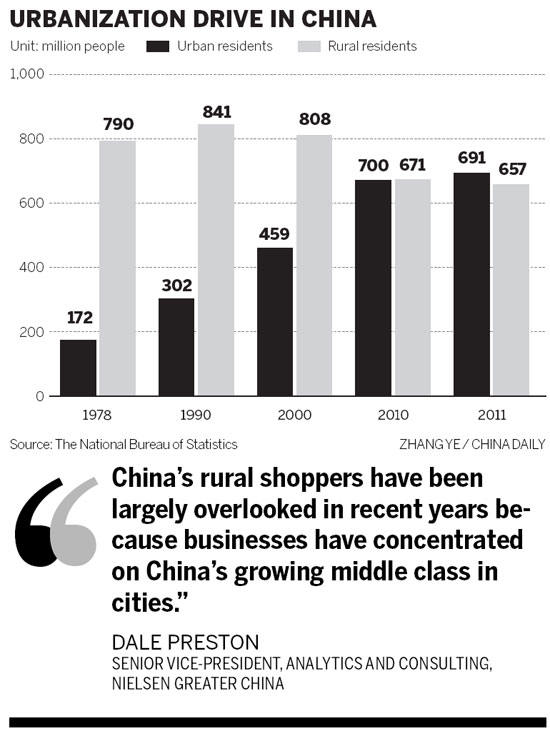
In the long-term background of world economic recession, the country's urbanization will continue to prop up the economy because there is much room for development in the next decade. Data from the National Bureau of Statistics show that as the urbanization rate reaches 30 to 70 percent, the process hits a period of fast development. According to the bureau, China's urbanization rate reached 51.3 percent in 2011. The figure will reach more than 60 percent in 2020.
"There's been a widely held assumption that when villagers migrate to work in urban areas, their increased earnings lead to higher spending, turning these consumers into urban shoppers," said Preston of Nielsen Greater China.
"The truth is, migrants actually maintain their rural shopper habits but work and sleep in an urban
According to the World Bank, migrants send home around $45 billion a year, with some sending 80 percent of their income to their families. Migrants also tend not to spend money in urban centers, leaving families in villages with more money, which is leading to increased spending on better homes, children's education, consumer durables and more premium groceries. "Theoretically, urbanization can expand domestic consumption, but the government first needs to be willing to spend on public services and infrastructure construction, as well as providing social welfare for the migrant workers," said Zhang Xiaoshan, an academic with the Chinese Academy of Social Sciences. "So, whether the government is willing to pay the huge bill is the key to sound urbanization." Liwoke@chinadaily.com.cn 2012 in review Year-ender: Domestic consumption in 2012 Previous reports Home prices depend on monetary, urbanization policies Shopping malls boom in China on urbanization China to advance urbanization next year


Copyright 1995 - . All rights reserved. The content (including but not limited to text, photo, multimedia information, etc) published in this site belongs to China Daily Information Co (CDIC). Without written authorization from CDIC, such content shall not be republished or used in any form. Note: Browsers with 1024*768 or higher resolution are suggested for this site.
License for publishing multimedia online 0108263 Registration Number: 130349