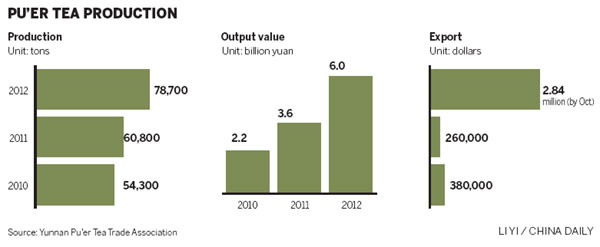
Output of Pu'er tea leaves in the region has not changed much during the years since 2007 but the purchase price has kept rising. Also, with sales improving, the revenue reached more than 6 billion yuan by last October, almost double the 3.2 billion yuan revenue in 2010.
The export value also jumped from $260,000 in 2011 to $2.64 million last year.
After the State Administration of Quality Inspection and Quarantine introduced geographic identification to Pu'er tea at the end of 2008 only tea leaves planted in Yunnan province qualify as genuine Pu'er tea.
The move has prevented some businesspeople from selling shoddy tea leaves under the Pu'er name and made the market more stable, Liu said.
|
 |
But local tea professionals want more done to make their treasure recognized by more people.
Liu and his colleagues are sending out a registration form to the 230,000 households of tea planters in Pu'er.
With help from the Chinese Academy of Sciences, they will build a database that can trace every tea leaf back to its tree's planter.
Meanwhile, the local government has earmarked a special fund of more than 70 million yuan to support some big tea gardens, standardize the planting, while also helping to renovate them as a destination for tourists.
"We want to learn from the successful experiences of French chateaus. Pu'er tea is as charming as French wine but we need modern operations to make it really shine," Liu said.
"It is very challenging to promote tea in countries where coffee drinking is mainstream," said Qi Xiaozhai, director of Shanghai Commercial Economic Research Center.
People in the United Kingdom or US also drink black tea but how do we persuade them to choose Pu'er? Convincing them that it is a healthy alternative to coffee would be a tough but essential step in any promotion, he added.
Qi also emphasized the importance of applying overseas food standards.
"For example, Chinese people love the fuss involving tea leaves because we believe it is a symbol of freshness. But many foreign people think it is not clean and they should not appear in tea products," he said.
According to guidelines from the Ministry of Agriculture issued in 2009, China is to build four concentrated tea-production areas and improve tea quality by employing better growing methods by 2015.
In 2009, China had 1.86 million hectares devoted to tea plantations, the largest in the world. China also produced the most tea that year, harvesting 1.35 million tons. More than 80 million people work in the industry as farmers, other workers and sales people. However, China doesn't have an internationally strong brand among its 70,000 companies.
xieyu@chinadaily.com.cn
Previous reports
Enterprises actively promoting skills in overseas markets


Copyright 1995 - . All rights reserved. The content (including but not limited to text, photo, multimedia information, etc) published in this site belongs to China Daily Information Co (CDIC). Without written authorization from CDIC, such content shall not be republished or used in any form. Note: Browsers with 1024*768 or higher resolution are suggested for this site.
License for publishing multimedia online 0108263 Registration Number: 130349