

 Comments
  Print
Print  Mail
Mail  Large Medium Small
Foreign bakery chains are accelerating their expansion into China, as local hunger grows for freshly baked bread, cakes and pastries.
Singapore bakery chain BreadTalk, for instance, said it has plans to increase its number of mainland outlets from 300 to 550 in the next couple of years.
George Quek, the company's founder and chairman, told China Daily he expects its mainland revenue to grow at least 30 percent a year, as Chinese consumers opt for a lunchtime sandwich, roll or baguette instead of more traditional fare.
"I expect a lot from the Chinese market, and I am confident it will keep on growing for years to come," said Quek, who first brought his brand to first-tier cities in 2003, and has been growing ever since.
Ask Quek what people like the most about his business, and as well as the obvious answer of taste, he said it's the process of making his bread which also attracts a lot of attention.
"We have opened up our kitchens to show people how bread is made. They can see that it is actually clean and fun, and they like that," said Quek.
Zhu Han, a PR industry account director in Shanghai, said her taste for lunchtime bread is pretty typical of her peers, and she now has sandwiches at least three times a week.
"It is clean, quick, and balanced in nutrition," she added.
"Usually when I have no time to cook or eat a formal meal, I will just grab a sandwich."
But there's a lot more to the Chinese bread industry than just a quick sandwich.
Quek's bakery chain has introduced 50 new creations for its latest launch in Shanghai. Ingredients such as Chinese yam and spinach, for instance, have been baked into their breads and pastries, to cater to the preference of Chinese people.
Quek said his strategy of giving a local feel to his products has been crucial to its success - a combination of blending the products with local tastes and flavors, and emphasizing the concept of freshly baked products being "healthy, and environmentally friendly".
In the past, many in China referred to baked bread products simply as xidian (Western dim sum) and they were rarely a staple of any traditional Chinese diet.
But nutritionist Shen Yin, from Shanghai No 10 People's Hospital, said that Chinese diets are changing fast, and that bread, cakes, and pastries have gained enormous popularity in recent years.
"More people, and especially children, are adopting Western diets nowadays," she said.
The creamy texture and rich, sweet taste of cake are very attractive to younger Chinese, while many white collar workers are turning to sandwiches for lunch, or as snacks during office hours.
"But we have to be careful," she noted.
Some cakes and pastries are high in "trans fatty acid", or unsaturated fat, which has been strongly linked to causing obesity, and heart and blood diseases.
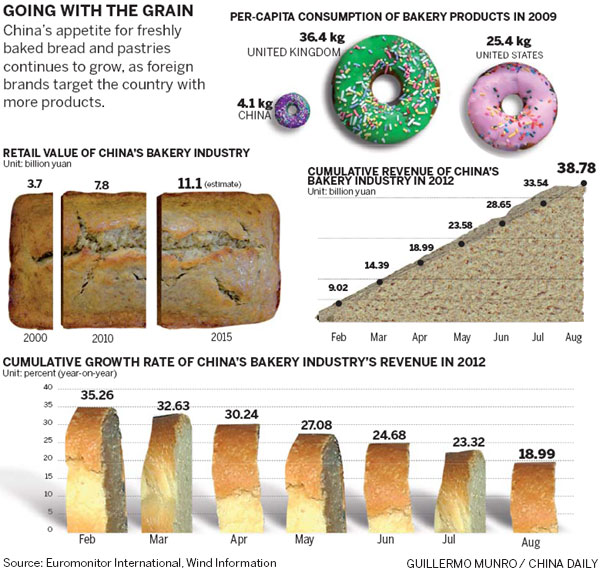
According to data from market researcher Euromonitor International, in 2010 the retail value of baked goods like bread, pastries and cakes in China was estimated at 7.8 billion yuan ($1.2 billion), up from 3.7 billion yuan in 2000.
Euromonitor estimated revenue could now grow to 11.1 billion yuan by 2015.
Per-capita consumption of bakery products in China was 4.1 kilograms in 2009, nearly double the 2.1 kg of a decade earlier.
Compare that with the 36.4 kg per capita in Britain and 25.4 kg in the United States, and the huge potential in China is clear.
Quek's revenue in China currently accounts for 32 percent of BreadTalk's total group revenue, and he's hoping to increase that to 50 percent in the next three years.
The company is in 46 Chinese cities, with plans to go into three to five more every year, tapping into the opportunities opened up by the urbanization of second-tier cites.
Quek said he expects to eventually have 200 outlets in Shanghai alone, where he currently has 40.
Other international brands targeting the Chinese market come from various countries, with Japan's Yamazaki and Paris Baguette from South Korea both expanding fast.
Locally, 85 C, a cafe and bakery specializing in coffee, cakes and bread from Taiwan, is also gaining great popularity, selling its goods 24-hours a day.
Wang Chunrong, the marketing director at Jing An Bakery, a legendary local bakery brand from Shanghai, admitted his firm is "under great pressure nowadays to compete".
In its early days, people would queue for hours to get a taste of its bread, said Wang, but as more foreign brands arrived, one by one since 2000, local bakeries have been losing market share.
"We used to have over 50 percent of the market share in Shanghai. But nowadays, I doubt if we have 2 percent," added Hunter Pan, Jing An's general manager.
The brand now has 44 outlets in the city, but has made a loss for the past two years.
With some recent private-equity investment, it has renovated some of its outlets and equipped them with advanced baking equipment, which it hopes will allow it to develop some new products.
Pan said Chinese people used to prefer soft bread, with sweet flavors.
But nowadays, the Western preference for healthier, whole grain or whole wheat bread is becoming popular.
"We plan to base our new products on that trend, and we are ready to fight back," he added.
Sales have been growing steadily this year, and as well as more products, Jing An has been selling franchises.
"Our bakery used to be the most renowned and chic food brand in Shanghai," said Pan. "But to revive it, we need to learn from the foreign counterparts."
xieyu@chinadaily.com.cn
 Disney Town staff members greet visitors with smiles
 Special session of internet conference held in Berlin
 Top 10 most attractive Chinese cities for expats
 High–tech gadgets, not girls, main attraction at Beijing auto show
 Infographic: Highlights of China Q1 economic data
 Top 10 luxury cars at Beijing auto show
 Highlights of smart hardware on display at 2016 GMIC Beijing
 Two students return from abroad to open beer factory
 China's manufacturing activity expands at slower pace

Copyright 1995 - . All rights reserved. The content (including but not limited to text, photo, multimedia information, etc) published in this site belongs to China Daily Information Co (CDIC). Without written authorization from CDIC, such content shall not be republished or used in any form. Note: Browsers with 1024*768 or higher resolution are suggested for this site.
License for publishing multimedia online 0108263 Registration Number: 20100000002731