Comments
  Print
Print  Mail
Mail  Large Medium Small
"The Chinese economy is going through a rapid evolution ... a huge amount of change at one time, so it is natural that it causes some dislocation and turbulence along the way," said Peter Sykes, Dow Chemical Co’s president in China.
The US-based company is the world's largest specialty chemical company by sales.
"Huge new opportunities will present themselves as the economy becomes more sophisticated. At Dow we remain very excited and we believe China will continue to serve as an important engine of growth for Dow and others — but a different kind of engine. "
Although some foreign companies are delaying their investment plans in China, Dow is beefing up its operations in the nation.
In June, Dow said it would invest in a world-class manufacturing facility on water treatment technologies in Huzhou, Zhejiang province. The new facility will become operational in 2013.
The company is also planning to expand its electronics manufacturing facility in Zhangjiagang, Jiangsu province.
Sykes said that Dow will continue to invest to further expand its manufacturing, innovation and operational networks in China over the next few years.
For Dow, the Chinese market is certainly a good bet. "If China continues its impressive track record of economic success, it will eventually become Dow’s largest global market, most likely sometime in the 2020-30 period," said Sykes.
After the figure expanded by more than 10 percent for years, China’s GDP growth slowed to 7.6 percent from April to June, the slowest pace in three years, but some economists say it has yet to bottom out.
Bank of America, Deutsche Bank and HSBC recently reduced their forecasts for full-year economic expansion. Premier Wen Jiabao in March set a target of 7.5 percent for this year.
But many foreign companies are taking a long-term view. China’s economic growth will probably recover late this year or early next year, as the Chinese government continues to stimulate growth, said Thieneman from Caterpillar.
Wang Zhile, a senior expert with the multinational company research institute under the Ministry of Commerce, said "it’s unnecessary to be that concerned about the drop in the nation’s FDI", as "the real estate sector is probably a key factor behind this".
As the realty sector grew speedily in China, the nation witnessed a huge influx of foreign funds into the sector over the past few years. But, with the central government’s tightening measures in the property sector, China saw a sharp decline in the amount of foreign capital flowing into the industry.
Of the 5.08 trillion yuan ($800 billion) invested in property development in China between January and July, only 22.8 billion yuan was made by foreign investors, a 54.3 percent decrease year-on-year, according to the National Bureau of Statistics.
"We actually have not felt any big change with foreign companies and manufacturers in sectors excluding realty," Wang said.
"The confidence is there."
After years of double-digit annual growth, China's FDI reached a record high of $116 billion in 2011. "The annual figure is expected to surpass $100 billion in the future, and annual growth could remain around 10 percent on average in the next decade."
Moving out
But the Chinese government’s concern is understandable, as a slew of foreign companies either transferred factories to neighboring nations, returned manufacturing activities to developed markets or suspended their expansion.
According to the Ministry of Commerce, from January to July, China’s FDI dropped by 3.6 percent year-on-year to $66.7 billion.
"The severe economic situation at home and abroad affected China’s FDI. We have to be alert toward this trend," said Ministry of Commerce spokesman Shen Danyang.
Slowing exports and economic expansion have cast a shadow over multinationals’ investment plans.
In July, the nation’s export growth slumped to 1 percent, the lowest since 2009. During his recent visit to Guangdong province, China’s export hub, Premier Wen said the difficulties in stabilizing economic expansion are "still relatively large" and called for measures to promote export growth.
Rising labor costs in the mainland have also squeezed corporate profits and even forced some to move elsewhere.
"For years, foreign investors and manufacturers mainly sought cheap labor in China, but more and more are shifting their focus to the consumer market as China’s growth model changes," said Wang.
"We have to accept that some have and would move out, ... but we should be encouraged to see that some others’ confidence in China is unshaken and a lot are focused on long-term growth."
Last year, the Obama administration announced the setting-up of a national promotion agency to attract more foreign investment, especially from China, as part of its efforts to create jobs and grow the economy.
And some companies, including General Electric Co, are reportedly planning to move some of their production back to the United States.
But for GE, this move will not slow its investment in China.
"China’s strategic importance to GE is supported not only by its manufacturing capability, but also its technology innovation," said a company statement.
And GE will continue to "look for investment opportunities" in the key industries it serves, "such as energy, healthcare and aviation", which is also well in line with China’s commitment to developing the high-tech sector over the next five years.
 Infographic: Highlights of China Q1 economic data
 Top 10 luxury cars at Beijing auto show
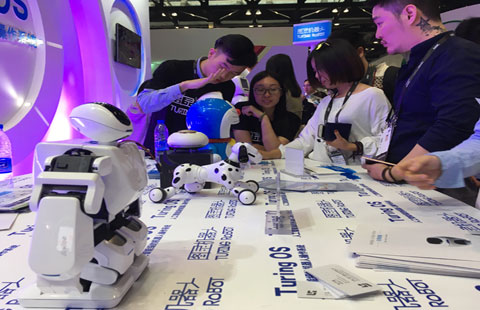 Highlights of smart hardware on display at 2016 GMIC Beijing
 Two students return from abroad to open beer factory
 Man aims to provide freshest ice cream possible
 Top 6 domestic new-energy vehicles at Beijing auto show
 Hanover Fair opens with Sino-German alliance launch
 Five Chinese companies with exclusive broadcasting rights to sports event

Copyright 1995 - . All rights reserved. The content (including but not limited to text, photo, multimedia information, etc) published in this site belongs to China Daily Information Co (CDIC). Without written authorization from CDIC, such content shall not be republished or used in any form. Note: Browsers with 1024*768 or higher resolution are suggested for this site.
License for publishing multimedia online 0108263 Registration Number: 20100000002731