Comments
  Print
Print  Mail
Mail  Large Medium Small
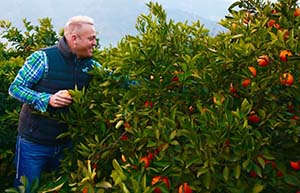
Every month, Li Lianfeng's textile mill in Guangzhou produces more than 7,000 meters of denim, which goes to jean companies as far away as Denmark, Australia and the United States. But only 5 percent of his mill's output uses natural indigo dye rather than synthetics.
"Still not many people know about it, so there also aren't many jean manufacturers that order it," says Li, 50, owner of Zhaofeng Textile and Apparel.
The company ventured into natural dye in 2007, upon the request of a Hong Kong client.

The colorant, extracted from the indigo plant, is apparently so eco-friendly that a man is shown on Li's blog licking the deep blue dye off his finger.
So why aren't Li's clients converting to natural dye? Cost is the underlying reason: The plant-dyed denim is four to five times more expensive than ordinary denim because indigo dye is harder to produce. And chemicals are still needed to help the plant dye penetrate cloth fibers.
"I'm doing business and my goal is to make a profit," Li says, "but my bigger hope is that while contributing to society's sustainable growth, I can also make money to nurture my business and employees."
Levi Strauss & Co, the inventor of jeans, seems to have found the formula to balance between making a profit and protecting the environment.
A year and a half ago, it put "water less" jeans on the market. Each pair, says the American company, is made with 28 percent to 96 percent less water than traditional jeans, thanks to innovation in the "finishing" process.
It reduced the process' usual three to 10 washing cycles - which consume around 42 liters of water - by using new methods, like combining multiple wet cycles into one and eliminating the use of water during stone washing.
"We challenged ourselves to operate at the intersection of style and sustainability," Erik Joule, Levi's senior vice-president for men's global merchandising and design, said in a statement introducing the product line in November 2010.
This spring, the company says, it put 13 million pairs of Levi's "water less" jeans on the international market. What percentage this is of the brand's total inventory, the company declined to say.
Half a year ago, Levi Strauss also began making garments with Better Cotton, cotton grown using less water and fewer pesticides while at the same time raising producers' labor standards and income levels.
The move followed a 2007 company-commissioned study on the life cycle of its jeans and khaki pants, which found that the biggest use of water and energy happens at the beginning and end of the garments' lives. That is, during cotton production and consumer use.
To address the latter, Levi's encourages its consumers to adopt more sustainable habits. Its product-care tags now tell users to wash jeans every other week instead of every week, wash them in cold rather than hot water, line dry instead of tumble dry and donate rather than throw away unwanted items.
This campaign received special mention at the Copenhagen Fashion Summit earlier this month, the world's largest conference promoting sustainable fashion, organized by the Nordic Fashion Association.
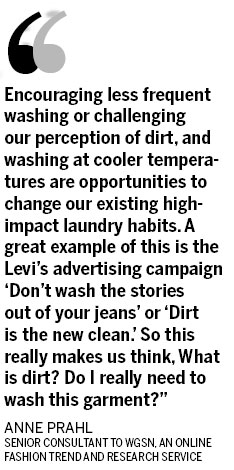
"Encouraging less frequent washing or challenging our perception of dirt, and washing at cooler temperatures are opportunities to change our existing high-impact laundry habits," Anne Prahl, a senior consultant to the London-based online fashion trend analysis and research service WGSN, says in her speech at the summit.
"A great example of this is the Levi's advertising campaign 'Don't wash the stories out of your jeans' or 'Dirt is the new clean.' So this really makes us think, What is dirt? Do I really need to wash this garment?"
In fashion, sustainability is becoming the new black.
Gucci, one of the most iconic Italian brands, this month replaced its rigid, laminated eyewear case with one that is foldable and recyclable.
This "will have a positive effect on transportation costs and carbon dioxide emissions," says Rossella Ravagli, the label's corporate social and environmental responsibility manager, who presented the new packaging during her talk at the eco-fashion summit.
Next month, Gucci will debut women's sandals made of biodegradable plastic. And in 2013, it plans to launch a line of environmentally friendly sunglasses made of recycled metal and "liquid wood", an alternative to the commonly used plastic.
"Our products have very high quality, and when I say quality, I mean sustainable quality," Ravagli says on the sidelines of the summit. "Quality also includes respect of person and the environment We need to enforce this message around the world."
As one of the most desired luxury brands in China, Gucci can certainly help raise domestic awareness of the importance of ethical, eco-friendly fashion.
 Top 10 Chinese internet companies
 Fun time for children at international toy expo in Beijing
 Huawei launches new smartphone P9 in Vietnam
 Top 10 box office movies on China market in H1
 Woman resigned from high salary job to make notebooks
 Hurun publishes Global Chinese Big Philanthropy Report 2016
 Top 10 new economy issues in China
 Wetland helps preserve ecology of Dianchi Lake

 Sports star Ivanovic, Schweinsteiger holds wedding in Venice
 Relive the glories and defeats in France-Germany rivalry
Copyright 1995 - . All rights reserved. The content (including but not limited to text, photo, multimedia information, etc) published in this site belongs to China Daily Information Co (CDIC). Without written authorization from CDIC, such content shall not be republished or used in any form. Note: Browsers with 1024*768 or higher resolution are suggested for this site.
License for publishing multimedia online 0108263 Registration Number: 20100000002731