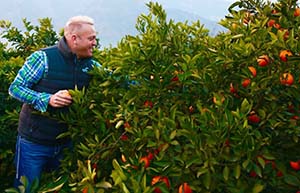
As the world's most populous country, China recorded a grain output of 589 million metric tons in 2012, the ninth consecutive year of growth, according to the National Bureau of Statistics.
Tang Huajun, deputy dean of the Chinese Academy of Agricultural Sciences, said climate change may partly have a positive effect on the country's grain output if the global trend continues.
"A 3 to 11 percent increase in grain yields per unit is foreseeable from 2030 to 2050, considering the higher emission of greenhouse gases," he said, citing a mid-term research result from his academy.
The five-year research project, launched by the CAAS in 2010, is designated by governmental authorities to monitor the impact of climate change on grain production.
"But in the meantime, a series of negative effects caused by climate change - extreme weather, such as drought and flood, as well as plant diseases and insects - will pose increasing threats to grain supply security," said Tang, chief scientist for the five-year research project.
Agricultural professionals also warned that other great challenges, such as population growth and arable land loss, will have potentially grave effects on China's ambitious target of maintaining grain self-sufficiency.
The country's population is expected to peak at about 1.5 to 1.6 billion in 2030.
China's arable land may shrink to 105 to 111 million hectares in 2050, well below the current 122 million hectares, the bottom line for arable land set by the government to satisfy agricultural production, said Tang.
The prediction was based on government data on the urbanization rate and arable land from 1980 to 2005.
"Compared with strong negative effects of the rising population and shrinking arable land, favorable conditions due to climate change are quite limited to the country's food security," said Tang.
Tang suggested China introduce more new varieties of crops, for instance drought-resistant varieties, to plant in southern regions to cope with local climate change.
His research project will work to predict future changes in the country's planting locations due to climate change, especially for the three food staples of rice, wheat and corn.
Contact the writers at jinzhu@chinadaily.com.cn and wangqian@chinadaily.com.cn.


Copyright 1995 - . All rights reserved. The content (including but not limited to text, photo, multimedia information, etc) published in this site belongs to China Daily Information Co (CDIC). Without written authorization from CDIC, such content shall not be republished or used in any form. Note: Browsers with 1024*768 or higher resolution are suggested for this site.
License for publishing multimedia online 0108263 Registration Number: 130349