'Will I get a pay rise?" This question is foremost on almost every wage earner's mind as the year nears its end.
The question, however, got a positive response from the two-day Central Economic Work Conference, which concluded on Dec 16, as the new Chinese leadership made economic restructuring by boosting domestic consumption and improving people's livelihood two of its six key tasks for next year. Increasing people's income, no doubt, will play an important role in achieving the two goals.
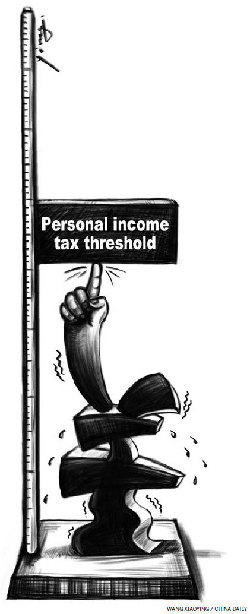 Accomplishing the goals will not be an easy task, though.
The income distribution reform plan, scheduled for later this month, has been deferred again until at least next March. The repeated delays in the implementation of the plan show how difficult and complex economic reform in China is. The Chinese leadership, however, should be more determined now than ever to implement the reform because the wealth gap has widened alarmingly.
The yawning income gap has further pushed up China's Gini coefficient - a widely recognized measure of wealth inequality, with anything above 0.4 being worrying. In a report published at the end of 2011, the National Bureau of Statistics said China's Gini coefficient in 2010 was slightly higher than that in 2000, which it put at 0.412. A recent Southwestern University of Finance and Economics survey on China's household financial conditions, however, put the country's household Gini coefficient at 0.61 in 2010, compared with the world's average of 0.44.
Though one or two surveys cannot reflect China's true picture, the trend of widening income gap should be a warning to Chinese decision-makers.
Of course, the wealth gap cannot be narrowed by simply "robbing the rich to help the poor", for it will not only create obstacles for the reform, but also lead to outsourcing of capital and even curbing economic growth. Nor can it be narrowed by forcing enterprises to raise the salaries of all their employees.
Maintaining growth is also a key task of the leadership next year. That means too heavy a burden should not be placed on enterprises. The impractical move of forcing enterprises to raise all their employees' salaries will increase their human resources costs and deal a deadly blow to the smaller ones. Thus the government has to navigate through the difficult waters of income distribution reform to achieve the different and sometimes, more or less, paradoxical goals.
A recent report by Towers Watson, a global advisory services company, shows that Chinese enterprises remain cautious about pay rise in 2013, and the average increase is expected to be 9.3 percent, slightly lower than 9.6 percent in 2012. Such an increase is not disheartening. But more importance should be paid to narrowing the income gap between companies' senior managers and ordinary workers.
Today, the income of China's highest 10 percent earners is 23 times that of the lowest 10 percent, compared with 7.3 times in 1988. According to a report published by the Ministry of Human Resources and Social Security in October, the incomes of management personnel have increased much faster than that of ordinary workers over the past five years, with the yearly salary of senior management personnel of listed companies rising from 291,000 yuan ($46,648.6) in 2005 to 668,000 yuan in 2010, an average increase of 18.1 percent.


Copyright 1995 - . All rights reserved. The content (including but not limited to text, photo, multimedia information, etc) published in this site belongs to China Daily Information Co (CDIC). Without written authorization from CDIC, such content shall not be republished or used in any form. Note: Browsers with 1024*768 or higher resolution are suggested for this site.
License for publishing multimedia online 0108263 Registration Number: 130349