|
 |
|
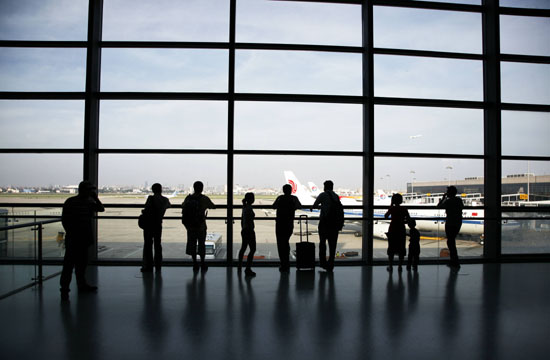
The terminal 2 building at Hongqiao International Airport in Shanghai. The National Development and Reform Commission approved 24 projects to build new airports and expand existing airports this year. The overall investment was estimated at about 100 billion yuan ($15.9 billion). [Photo/China Daily]? |
Local governments drive expansion in the sector with lofty goals, raising fears of overcapacity
As the global aviation industry is being hit by a downturn due to flagging tourist demand, China is seeing an airport construction boom driven by local governments.
Last month, Hunan province said it planned to build 21 general aviation airports in the next 18 years.
Earlier, neighboring Hubei province also said it would build seven commercial airports and two general aviation airports in the next 18 years.
General aviation airports are designed to handle four to 10-seat aircraft, as well as planes used for agricultural, industrial and rescue purposes.
The lofty goals - though still in the public consultation phase - stirred media debate, and raised questions about the need to have so many airports in the two provinces.
In July, the State Council issued a document to encourage the development of China's civil aviation industry. In the same month, the Civil Aviation Administration of China, or CAAC, said that the country plans to build 82 new airports and expand 101 existing ones across the country from 2011 to 2015.
This year alone, the National Development and Reform Commission, the country's top economic planning agency, approved 24 projects to build new airports and expand existing airports, with an estimated investment of around 100 billion yuan ($15.9 billion).
Li Jiaxiang, head of the CAAC, said that China's civil aviation development required some degree of "advanced thinking".
"China now has only 182 commercial airports. The number is no more than 300 if general aviation airports are also counted. I would say that the airport sector in China is underdeveloped, rather than overdeveloped," Li said.
However, Li admitted that most of China's airports are now running at a loss. Of the 180 airports China had in 2011, 130 were in the red, with a combined deficit of about 2 billion yuan. In a recent report, the Beijing Evening News said that almost all of the country's feeder airports are posting losses.
So why are so many local governments rushing in to build airports?
Local governments' logic
"Wutaishan Airport will not only shorten the distance between Yizhou and the world, bringing convenience to residents conducting economic and trade activities, but will also boost domestic demand, increase consumption and benefit the people," Dong Hongyun, Party secretary of Yizhou, Shanxi province, said at the airport's groundbreaking ceremony in June 2010.
The Wutaishan Airport is just one of three airports being built in Shanxi. If they are all completed, there will be seven airports in the province, which is about the same size as the United States state of Georgia.
According to the Shanxi statistics bureau, 80 percent of the province's passengers use the provincial capital's airport. This means that the other six airports will have to share the remaining 20 percent of traffic.
But few of the officials in these areas seem to take heed of this fact.
Dong's words reflect a recurring narrative among officials in most hinterland cities: that airports are needed to be prosperous, and that they will boost local GDP and create many business opportunities in commerce, tourism, logistics and real estate by cutting travel times.
"You cannot consider airports as isolated businesses," said Zou Jianjun, a professor at the Civil Aviation Management Institute of China. "Why not see them as public utilities like highways or a sewage system? Airports may benefits to the local economy."
China's airports are built and run by local governments, just like public utilities. And the governments are obliged to pay operators for any losses.
In 2011, local governments had to pay on average 15 million yuan for loss-making airports, according to a CAAC report.
But to many local officials, the sum is insignificant compared with the many huge business opportunities that they envision.
An official in Fuyang, Anhui province, said that, although the local government paid 60 million yuan for the city's airport, the overall dividends now amount to 600 million yuan.
Ten years ago, flocks of hens strolled on the idle runway, as lackluster traffic flow forced the airport to close. But now, Fuyang airport is seeing a steady rise in passengers.
In 2009, passenger flow was just 17,666, but the next year it jumped to 110,000.
Zou, a supporter of the airport construction boom, said that if an airport is designed scientifically, it will have a positive effect on the local economy, regardless of its size.
"Two preconditions are critical when planning a new airport: the prosperity of the local economy, and abundant resources like mining, agricultural or tourism resources. If these conditions cannot be met, then an airport can hardly make a profit," Zou said.
Zhang Qihuai, an aviation researcher with the China University of Political Science and Law, said that sufficient passenger flow is essential to an airport. But the problem is that the poorer a city is - which means low passenger flow - the more the local officials will be in a hurry to build an airport, which is why most money-losing airports are in central and western China.
"Running an airport is not only about building an airport. It's much more about funding, management, coordination with airlines, and qualified staff. Most feeder airports simply don't have these things," Zhang said.
The current scenario is that local governments tend to be overoptimistic about traffic flow estimates when submitting proposed airport construction projects.
Excessive optimism often leads to over-sized runways and terminals, and eventually, huge losses.
"Airport design projects do need certain forward-looking characteristics. But local governments should also be realistic about the airports' prospects," said Zou. "Unfortunately, most local officials prefer large-scale projects, it's like they are ashamed to build a small airport."
In some cases, the hastily built airports also pose safety issues.
In 2010, an airplane crashed when trying to land at the Yichun Airport, Heilongjinag province, killing 42 people.
The investigations that followed revealed that the airport had not been approved by the relevant authorities.
"We should learn from the Yichun accident: Reckless building projects can not only lead to financial losses, but also to grim security consequences," Zhang said.
zhengyangpeng@chinadaily.com.cn


Copyright 1995 - . All rights reserved. The content (including but not limited to text, photo, multimedia information, etc) published in this site belongs to China Daily Information Co (CDIC). Without written authorization from CDIC, such content shall not be republished or used in any form. Note: Browsers with 1024*768 or higher resolution are suggested for this site.
License for publishing multimedia online 0108263 Registration Number: 130349