Engineers test new mobile grid ahead of launch of revolutionary technology
A bus installed with professional testing equipment is driven slowly along the main roads in Qingdao's Huangdao development zone. Engineers watch a screen in the center area of the vehicle, checking ever-changing numbers that reflect the status of a TD-LTE 4G trial network.
The average download rate is around 35 megabits per second, with the maximum rate sometimes reaching 95 mbps. When engineers open a popular TV drama on the Chinese video website Youku.com, there is almost no download waiting time and the picture quality is good.
|
 |
|
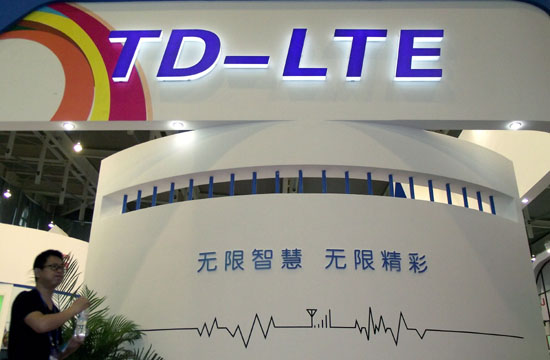
China Mobile demonstrates its Four Generation Time Division Long Term Evolution technology at a telecommunication fair in Nanjing, the capital city of Jiangsu province. [Photo/China Daily]? |
It is a common scenario for Ericsson China's engineers on the newly constructed TD-LTE trial network. TD-LTE stands for Time Division Long Term Evolution technology, one of the international 4G mobile telecommunication standards. It is a homegrown technology largely promoted by China Mobile Ltd, the nation's biggest telecom carrier.
Li Jiangli, senior customer solution manager at Ericsson China, said the TD-LTE trial network Ericsson built in Qingdao has been very successful and demonstrated a much superior performance than the current 2G and 3G mobile networks.
"Compared with 2G and 3G networks, the TD-LTE network will enable people to do more things with mobile phones. For example, you can watch movies, have video conferences and complete tasks that use large data traffic," Li said.
Telecom equipment vendors including Ericsson are closely cooperating with China Mobile to deploy and test TD-LTE trial networks. Only through various tests under different circumstances can equipment suppliers gather experience and prepare well for their future commercial use, she added.
In Qingdao, Ericsson tested the possibility of updating GSM 2G base stations directly to the 4G TD-LTE base stations. "The solution does not only provide quality 4G functions but also greatly reduces the construction cost for telecom operators," said Chang Gang, chief marketing officer of Ericsson China.
China Mobile owns most of the nation's GSM base stations and operates one of the world's most efficient GSM networks. The number of China Mobile's GSM stations is more than double the carrier's TD-SCDMA 3G base stations. By making better use of its GSM 2G resources, China Mobile can deploy a 4G network in a much shorter time because it takes only one hour to update a 2G station, Chang said.
China Mobile has been officially running the second phase of its scale-trial of TD-LTE technology in 13 Chinese cities since June. In addition to Ericsson, other leading telecom equipment vendors such as Huawei, ZTE and Alcatel Lucent have all participated and come up with new solutions and applications for the TD-LTE network.
In Hangzhou, people can experience TD-LTE network's high-speed data transfer in buses. In Shenzhen, when the 26th Summer World University Games opened last year, media reporters were already able to shoot videos and send them back to editing platforms immediately via a TD-LTE trial network.
"The world's 4G network development is gaining momentum. There is a clear trend in that all telecom equipment vendors are actively joining China's 4G development," said Huang Meng, a telecom analyst at Beijing-based research firm Analysys International.
The increasing 4G activity is largely driven by positive signals released by Chinese government and telecom operators recently, analysts said.
Miao Wei, minister for industry and information technology, revealed the Chinese government would soon grant 4G licenses to telecom carriers. The government will issue 4G licenses over the coming year, Miao was quoted as saying in a China National Radio report.
The ministry officially defined the TD-LTE spectrum - 2,500-2,690 MHz - in China in October, paving the way for future TD-LTE network commercial use.
Xi Guohua, chairman of China Mobile, said in June that China Mobile plans to have a total of more than 200,000 TD-LTE base stations through new builds and upgrades by 2013.
Rumors have circulated in Chinese media that China Telecom, the nation's smallest mobile carrier, will probably adopt TD-LTE technology when it starts to deploy its 4G network. If true, it would be a great boost for the TD-LTE industry both at home and abroad.
shenjingting@chinadaily.com.cn


Copyright 1995 - . All rights reserved. The content (including but not limited to text, photo, multimedia information, etc) published in this site belongs to China Daily Information Co (CDIC). Without written authorization from CDIC, such content shall not be republished or used in any form. Note: Browsers with 1024*768 or higher resolution are suggested for this site.
License for publishing multimedia online 0108263 Registration Number: 130349