The aviation giants - US-based Boeing and French-based Airbus - have held dominant positions as aircraft manufacturers worldwide. Their supremacy seems indestructible and smaller rivals face insurmountable odds to grab a larger market share. Nevertheless, Chinese companies have raised their stakes to compete in the sector.
|
 |
|
Tom McGregor |
The Chinese economy is rising rapidly and at a faster pace than the rest of the world. Accordingly, one would expect its aviation sector to enjoy greater success. But Chinese manufacturers have struggled to lift off.
"Comac, China's would-be rival to Airbus and Boeing, has announced 50 new jet orders," according to the Financial Times, "but also admitted it is struggling to get its aircrafts off the ground."
China's aviation companies remain optimistic, despite recent problems, such as delays with meeting production deadlines and hiring scientific and engineering experts for designing aircraft parts on assembly lines in the country. Yet everything seems to be falling into place nowadays and the domestic aviation sector stands poised for liftoff.
The Chinese media is reporting that, "Commercial Aircraft Corp of China Ltd predicted the China market will need 4,960 large passenger aircraft worth $563 billion by 2031, made up of 3,405 single-aisle aircraft, 868 twin-aisle airplanes and 687 regional."
It added, "Aviation Industry Co of China forecast China will have 4,933 new passenger aircraft by 2031, including 4,041 large jet liners and 829 regional jets, and China's fleet will grow to 6,309 aircraft, which is 3.6 times the current fleet."
Chinese aircraft companies could see its share of global operations passenger aircraft rising from 10 percent right now to 16 percent by 2031. That sounds fantastic, but we must remind ourselves of a famous adage: "Life doesn't always go according to our plans." The same would apply to China's aviation sector as well.
AVIC has outlined a detailed plan that looks flawless, but what happens when unexpected problems develop, such as technical glitches on assembly lines or delays with shipping and logistics? Does AVIC have backup plans to meet any and every contingency?
The forecast of 16 percent of market share in the global aviation sector appears to dismiss the probability that aircraft manufacturers from other companies could be hatching major expansion plans in the future. It's best for Chinese companies to prepare for all possible circumstances, whether good or bad scenarios, to adapt to a business climate that can dramatically change at any given moment.
AVIC has taken the right approach to boost its research and developments on engines investments.
At this year's China's International Aviation & Aerospace Exhibition in Zhuhai, Guangdong province (Southern China), Zhang Jian, vice-president of AVIC's Engine Holdings Co Ltd, held a press conference.
"We estimate the accumulative investment nationwide in the short run will surpass 10 billion yuan ($1.58 billion)," he said.
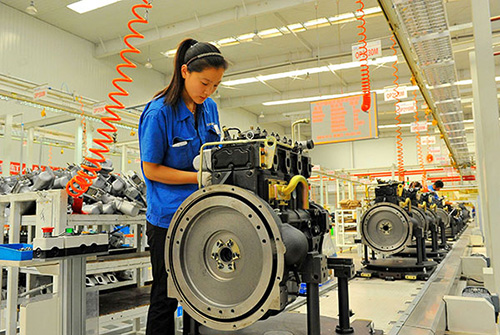
The company employs over 80,000 workers to produce jet engines for military and civilian planes. Its sales revenues have reached 40 billion yuan in 2011.
Investing more heavily in R&D would be crucial for Chinese aviation companies to expand in a sustainable manner. Perhaps, they can discover cheaper, more efficient and innovative methods to manufacture aircraft of all sizes.
Additionally, buying private jets in China is growing in popularity. "In 1997, Broad Group's CEO and Chairman Zhang Yue purchased a Cessna Citation jet and became China's first personal aircraft owner," according to the China Daily. "By the first half of 2012, the number of the country's private business aircraft rose to 126."
Prospects look even brighter. The Hurun Chinese Luxury Consumer White Paper 2012 disclosed that 63,500 Chinese have minimum assets of 100 million yuan and 13 percent of them plan to buy a business jet.
Chinese aircraft companies should focus more on the market for manufacturing private luxury jets to help them soar above their global competitors.
The views do not necessarily reflect those of China Daily.
Mcgregor@chinadaily.com.cn


Copyright 1995 - . All rights reserved. The content (including but not limited to text, photo, multimedia information, etc) published in this site belongs to China Daily Information Co (CDIC). Without written authorization from CDIC, such content shall not be republished or used in any form. Note: Browsers with 1024*768 or higher resolution are suggested for this site.
License for publishing multimedia online 0108263 Registration Number: 130349