Comments()
  Print
Print  Mail
Mail  Large Medium Small
But, he also had some harsh words for a few of his suppliers who he claims to be too "materialistic" and "tend to go overboard with me". "They're never quite contented with what I'm paying them for their stuff," says Sam.
"Tai Pak" has been peddling waste materials for the past four years, but due to physical constraints, he is able to rake in only a few hundred dollars a month - far less that what his peers are making.
"I'm quite happy with it though. I would like to earn more if my health allowed," he explains.
|
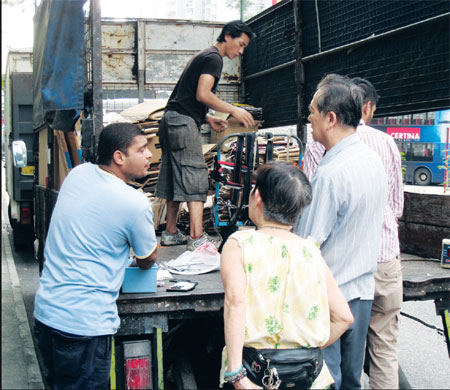 Sam and his staff attend to his customers at one of their meeting points in Wong Tai Sin. [Photo/China Daily] |
Many of "Tai Pak's" elderly acquaintances have been in the business even longer. Some are not even on the dole because "they care about dignity" and prefer "not to be bombarded with sneers and petty insults" from neighbors they believe would follow if it were known they depended solely on welfare aid. He wants the Hong Kong government to be aware of what needy people are doing and take an interest. Not everyone who has a conscience wants to rely on pure handouts for a living.
To meet growing demand, Sam works virtually non-stop from 9 in the morning to 8 pm, shuttling between up to six collection points in Kowloon and his tiny ramshackle shop in To Kwa Wan.
The only time he has for a meal would be a few bites over a lunchbox in between.
"When I first got into the business, I had only 20 or so suppliers. That was six years ago. Now, I have about 300. The news spreads like fire, and everybody jumps onto the bandwagon," recalls Sam.
The self-styled entrepreneur had up to 10 workers at one stage, but that's now down to half. They work seven days a week. "Probably, they've learned the ropes and started the same business on their own," he joked.
|
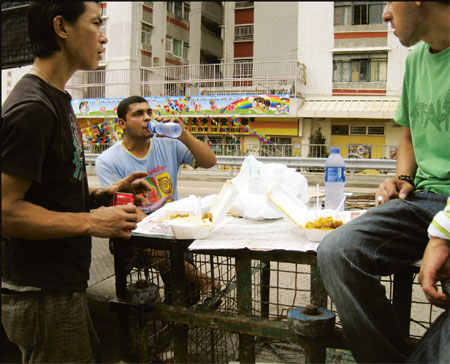 Lunch break for Sam and his staff in between transactions - the only time he has for a meal. [Photo/China Daily] |
His assessment may be valid, taking into consideration that he currently handles an average of seven tons of waste material every day, and having to fork out about HK$6,000 to suppliers every day.
"This is simple arithmetic. So, maybe, a lot of people envy me and what I'm earning, and would like to take the plunge themselves," he adds.
Based on his estimates, there are about 1,000 such "environmental" shops in Hong Kong, with 30 percent also involved in the recycling business. Everything occurred over the past two or three years, Sam says.
The biggest operator, he says, collects up to 400 tons a day.
The Shuen Wo Waste Paper Company at Cha Kwo Ling is reputed to be the biggest wastepaper collection center in Hong Kong. That is where all the materials collected are separated, weighed, compressed and packed to be transported to recycling plants on the mainland.
Sam believes that if the recycling business picks up further, and the local economy goes down, the number of "environmental" shops could escalate, which he argues, would also go a long way to help the authorities spread and execute the green message to the community.
Hong Kong's poverty problem is an unending story.
According to the HKCSC's latest report, there's no let up in the ever widening poverty gap, although figures show that the number of people living below the poverty line, particularly the elderly, declined to just above 17 percent last year.
 Fiber art show to be held in Nantong
 Potted vegetable, consumers' new favorite
 Tea ceremony added to flight training
 Modern agriculture pushes county forward
 Robots rule industry fair
 Affordable housing brings warmness to low-income group
 Zhengzhou intl auto show sees record car sales
 Rural drinking water project successful
Copyright 1995 - 2010 . All rights reserved. The content (including but not limited to text, photo, multimedia information, etc) published in this site belongs to China Daily Information Co (CDIC). Without written authorization from CDIC, such content shall not be republished or used in any form. Note: Browsers with 1024*768 or higher resolution are suggested for this site.
License for publishing multimedia online 0108263 Registration Number: 20100000002731