Comments()
  Print
Print  Mail
Mail  Large Medium Small
Cost advantage
As an extremely capital-intensive industry, the building of nuclear power plants requires huge initial investments including the overnight construction costs of materials and labor as well as capital funding.
Overnight cost is the term used to describe the cost of a construction project, especially in the power sector, if no interest was incurred during construction, as if the project was completed "overnight."
 China's strong capital position has made it an increasingly attractive investor when many developed countries are faced with budget constraints amid current economic woes and an unprecedented need for capital to upgrade aging nuclear energy facilities.
In addition, China's ability to build nuclear power plants more cheaply than its Western counterparts also allows it to beat international competition easily, analysts say.
According to an IEA/NEA study on the cost of generating electricity in 2010, the overnight costs for Chinese plants using AP1000 reactor stood at $2,300 (1,778 euros) for every kilowatt of capacity while overnight costs for an EPR (European Pressurized Reactor) in Belgium could reach $5,400 per kW.
Western nuclear companies including the France-based Areva and US-based Westinghouse are already looking to export new nuclear reactors in collaboration with Chinese partners.
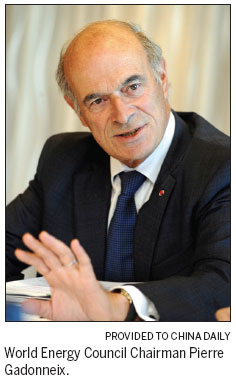
"The cost of building nuclear plants have been rising in order to meet the required higher safety standards since the Fukushima crisis," says Pierre Gadonneix, chairman of the World Energy Council and former chief executive officer of French energy firm EDF.
"China's involvement in building nuclear plants can make the costs as low as possible," he says.
The British government previously looked to deep-pocket Chinese investors to help revive its aging nuclear power sector. But the withdrawal of Chinese enterprises in the Horizon project may cause the country to suffer a major blow in its nuclear development plan, analysts say.
International alliances
Forming alliances and strategic partnerships with major global nuclear players has proved to be a successful way for Chinese nuclear enterprises to gain a foothold in the international nuclear market.
France is one of the countries that has a long-standing relationship and cooperation with China in nuclear technology and power plant development. This year also marked the 30th anniversary of the China-France nuclear partnership.
In 2007, French nuclear group Areva SA and CGNPC signed a nuclear agreement of 8 billion euros, the largest deal in the history of China's nuclear development. The two companies also set up a joint venture in 2008 and are jointly bidding for overseas projects using an existing cooperation model in the Chinese market.
"China has chosen third-generation technology for its new power plants in the domestic market. In the years to come, China will be a main actor in the nuclear power development worldwide," says Jerome Rosso, Areva's press officer.
 |
|
Bernard Bigot, chairman of the French Alternative Energies and Atomic Energy Commission, says cooperation between China and France in nuclear power will be a win-win partnership. [Provided to China Daily] |
"It's a win-win partnership. If China selects the French technology and shares the construction experience, we will be able to make some joint offers or bids in other countries that plan to develop the nuclear power," says Bernard Bigot, chairman of the French Alternative Energies and Atomic Energy Commission.
The global nuclear strategy partnership between China and France will continue to strengthen under the government of French President Hollande although he has vowed to cut the share of nuclear power to 50 percent in France's total energy mix, Bigot says.
"France is wishing to go on with nuclear energy with good industry capacity," he says. "China can benefit from France's long experience with nuclear plants that have been built, operated and maintained in a very safe way and in a way accepted by public opinion."
Industry experts have also called on China and France to jointly establish the international governance on nuclear safety under the G20 framework.
"China and France are in a legitimate position to promote this kind of governance, which is crucial to make nuclear energy more acceptable to the public in countries where it already exists and in countries that are newcomers to the sector," WEC chairman Gadonneix says.

 Domestic auto lineup looks overseas
 Electric car industry in the slow lane
 Brighter days for solar power
 Market flat, Japan-brand sales plummet
Copyright 1995 - 2010 . All rights reserved. The content (including but not limited to text, photo, multimedia information, etc) published in this site belongs to China Daily Information Co (CDIC). Without written authorization from CDIC, such content shall not be republished or used in any form. Note: Browsers with 1024*768 or higher resolution are suggested for this site.
License for publishing multimedia online 0108263 Registration Number: 20100000002731