|
 |
|
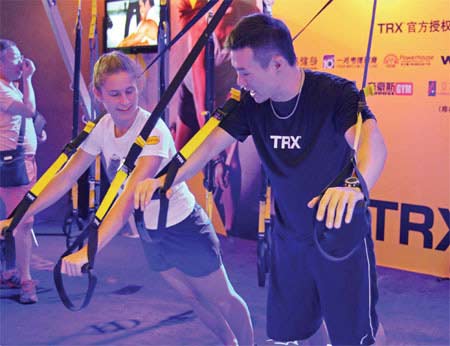
A coach gives an exercise tip to a visitor at the China Fitness Summit in Beijing. Provided to China Daily |
China's fitness industry lacks muscle and suffers from growing pains
The American economist Paul Zane Pilzer predicted in his 2002 bestseller The Wellness Resolution that preventative medicine and fitness would be the next trillion-dollar industry. This should have been particularly true in China, where there is an expanding mass of people with the time and money to feed their desire to keep fit and healthy. But there has been no easy money in China's fitness industry, judging by the performances so far of both international and homegrown fitness centers.
Surprisingly, brands with foreign investment hit the wall first. The joint venture of the former US fitness giant Bally Total Fitness and China Sports Industry Group, formed in 2001, has reduced the number of its gyms from 44 at its peak in 2008 to less than 30 today.
Others have changed ownership. California Fitness Clubs, which used to be under the umbrella of the US- based 24 Hour Fitness, were sold to the Ansa Group in August, making it a local brand.
"The international clubs that have a difficult time in China are franchises, and they just have one concept for their gyms in different countries and cultures," says Theo Hendriks, CEO of Sports and Leisure Group, a fitness company in the Netherlands.
Hendriks once declined to become a partner of 24 Hours due to its inflexibility.
"In Holland, we look at our wallets carefully," he says. "If we do not use the swimming pool, we want a discount. But the big firm says no, take it or leave it."
Walter Macdonald, founder of the wellness management company WM Consultants, who has been in the industry in China for 17 years, believes most international fitness firms do not understand the Chinese market.
"All the ideas that work in the West mostly don't work here," he says. "Fitness is not like fast food chains that can easily change the menu according to local taste."
But no one doubts the immense market potential in China. The penetration rate of fitness facility members in the US is 16 percent. It's 15 percent in the Netherlands and 13 in the UK. In the Chinese mainland, it's only 0.3 percent, according to Hendriks.
In market size, $31 billion (23.8 billion euros) a year is spent on fitness in Europe, he says. In the US, it is $25 billion, but only $11 billion in Asia.
"The penetration rate in China will at least rise to 3 percent in 10 years," Hendriks claims. "Which means there will be 16,000 clubs in the Chinese mainland and about 40 million people going to gyms."


Copyright 1995 - . All rights reserved. The content (including but not limited to text, photo, multimedia information, etc) published in this site belongs to China Daily Information Co (CDIC). Without written authorization from CDIC, such content shall not be republished or used in any form. Note: Browsers with 1024*768 or higher resolution are suggested for this site.
License for publishing multimedia online 0108263 Registration Number: 130349