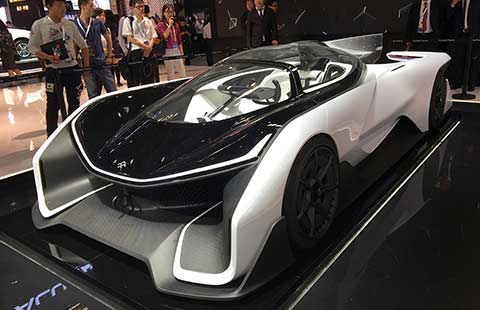
Due to the difficulty of making quick money in the electric vehicle market many Chinese automakers, including FAW, have switched their focus to hybrids, which are cheaper and do not run the risk of running out of battery mid-journey.
Even Japanese automakers have found it hard to break the deadlock in the Chinese EV market.
Sharon Shen, general manager of the public relations and brand department of Nissan China Investment Co, says the Chinese EV market is far from mature.
"Although in North America and Europe Leaf is witnessing decent sales, in China we are still conducting pilot operations with local governments, and collecting feedback and data from operators," she says.
Shen says it is hard to predict when the Chinese market will be ready to embrace the electric vehicle era, as it is highly subject to government policies.
 |
The subsidy varies depending on the type of vehicle. For electric buses, the subsidy from central government can be as much as 500,000 yuan. For passenger cars, the highest amount offered - 123,000 yuan, with 60,000 yuan coming from the central government and the remaining 63,000 yuan from the local government - is in Hangzhou.
Shen says the company is working with its joint-venture partner Dongfeng Nissan to develop a business model for Leaf, including the possibility that Nissan makes Leaf as a brand under the joint venture in order to jump policy barriers.
|
|||
"In my opinion, medium to large vehicles should be hybrid and smaller vehicles like passenger cars should adopt the EV mode, traveling shorter ranges such as 50 km, as an urban commute vehicle," Wang says.
Ren Yong, general manager of Chongqing Changan New Energy Automobile Co, agrees.
"In China, the operation mode is really important because it determines whether electric vehicles are viable in the market," Ren says.
"EVs cannot be sold partly because they take a long time to charge, while it takes just a few minutes to refill a gas tank."
Jacques de Selliers, founder of Going-electric, an association for electric vehicles in Europe, says it is hard to find early buyers, but once EV deliveries reach a "critical mass", the industry will see stable growth, as it does in Europe.
Although the Chinese government offers the most generous financial incentives in the world, this does not necessarily help to encourage the production of electric vehicles, de Selliers says.
"The Chinese government is building charging stations and encouraging people to use them like gas stations, but there are never enough due to the density of the Chinese population," he says.
De Selliers believes charging poles in communities should be built to overcome this.
"And besides this, the government should offer privileges such as lanes dedicated to electric buses and cars, and free parking," he says.
wangchao@chinadaily.com.cn
For more subscription details of Auto China, please visit our E-Shop.


Copyright 1995 - . All rights reserved. The content (including but not limited to text, photo, multimedia information, etc) published in this site belongs to China Daily Information Co (CDIC). Without written authorization from CDIC, such content shall not be republished or used in any form. Note: Browsers with 1024*768 or higher resolution are suggested for this site.
License for publishing multimedia online 0108263 Registration Number: 130349