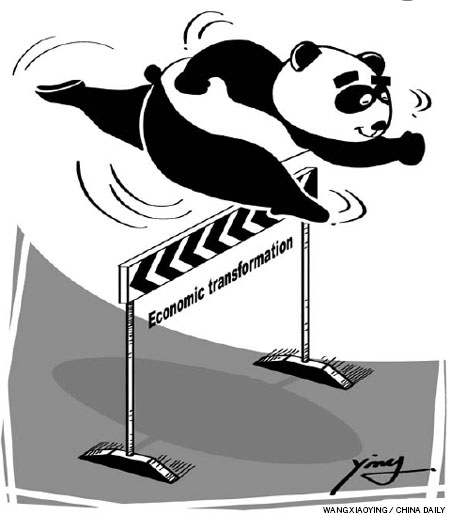
China's National Bureau of Statistics reported last week that the economy rebounded in September. While the third quarter's growth was slower (7.4 percent year-on-year) than the second quarter's 7.6 percent, growth picked up quarter-to-quarter. Data on industrial production and fixed asset investments suggested that China's economy, along with inflation and export growth, was bottoming out.
While the media and market have been pre-occupied with China's recent slowdown, it's steering China's transition away from the resource-intensive growth model that will be the challenge for the incoming leadership. Going forward, reforms - in the fiscal system, the enterprise sector, and factor markets - will have to be accelerated for effective rebalancing processes, not only from external to internal demand, but also in economic activity, from rural to urban areas.
On one hand, the transition from foreign to domestic demand has taken place: the 2008 stimulus package absorbed much of the excess savings, resulting in a sharp decline in China's trade surplus, from more than 8 percent to around 2 percent last year. The shift in economic activity from rural to urban areas is also underway: Urbanization has raised demand for services and goods from the expanding middle class; interior regions have been growing more rapidly than those along the coast, some in double digits, in recent years.
Seen another way, reforms in the fiscal system, the enterprise sector and factor markets will promote the structural shift from the investment-driven coast to consumption-driven interior. Lower wages and rents in the interior could develop a production network serving both domestic demands and even some export industries. These reforms will also facilitate the spatial transformation to ensure an optimal pace and pattern of urbanization.
So what should be changed in the fiscal system, the enterprise sector and factor markets?
The fiscal system: Public investments in basic amenities and recurrent expenditures to deliver social services will expand, and will be increasingly borne by local governments. Such increases will need to be achieved while maintaining fiscal sustainability, avoiding levels of taxation that harm growth, and strengthening fiscal institutions.
The key measures are to align revenue with expenditure responsibilities by re-centralizing some functions while allowing local governments to collect local taxes; and bring sub-national government borrowing and spending on budget, subject to regulatory oversights.
The enterprise sector: A central element is to increase competition between State-owned and non-State enterprises, especially in the "strategic" industries to prevent the abuse of market power from becoming a drag on the economy. This requires dismantling monopolies and oligopolies, and lowering entry barriers into State-dominated activities.
Further efforts and greater support for the private sector through diversified sources of financing will be crucial. After all, the rapid growth of the last three decades had been a result of allowing the private sector to play a significant role.
The factor markets: While extensive liberalization has occurred in product markets, continued distortions remain. The ability of governments to capture rent through their land institutions exacerbates the fiscal system. The differential treatment meted out to migrant and residential workers weakens the forces of urbanization and exacerbates social tension. The differential access to finance between State-owned and non-State enterprises distorts China's industrial structure.
In land markets, land tenure security and property rights, particularly in rural areas, should be ensured; the role of the State in land allocation or conversion should be minimized so land transactions can be more responsive to market needs; comprehensive land use planning in rural and urban areas must be introduced; and taxation of land and property should be instituted to ease the heavy reliance of local governments on land sales to generate revenue.
In labor markets, mobility has been hindered by the hukou (household registration) system. Workers are not moving with ease to the most productive and best paying jobs. With the expectant shrinking of the labor force in a few years, labor markets will have to be even more flexible to allocate hundreds of millions of migrant workers across sectors and areas; and labor market institutions must provide portable rights for affordable healthcare and social security. Equal opportunities to access jobs, education, and healthcare services will form the bedrock of policies for China's transition to an innovative, modern, and high-income economy.
In capital markets, recent reforms to introduce more flexibility exchange and interest rates are positive steps, but more importantly, competition should be introduced and regulation and supervision strengthened. To this end, financial institutions should be commercialized to meet varied demands of households, enterprises and governments. Financial infrastructure and its legal framework need to be upgraded, and a system for crisis management and insolvency schemes developed.
Sequencing the reforms is important. Front-loading fiscal reforms to eliminate off-budget borrowing by local governments; channelling SOE dividends to the budget; introducing new tax instruments, such as land and property taxes will create conducive conditions for more effective enterprise and factor market reforms. Introducing competition to State-dominated sectors will pave the way for SOEs' reform.
Lastly, price, regulatory and institutional changes in factor markets are essential. Actions such as improving the fiscal strength of local governments, introducing competition to "strategic" sectors and ensuring factor-input flow into activities that yield the highest returns shall contribute to the desired structural transition.
Chorching Goh is lead economist for China, Mongolia, and South Korea, and Klaus Rohland country director for China of the World Bank.


Copyright 1995 - . All rights reserved. The content (including but not limited to text, photo, multimedia information, etc) published in this site belongs to China Daily Information Co (CDIC). Without written authorization from CDIC, such content shall not be republished or used in any form. Note: Browsers with 1024*768 or higher resolution are suggested for this site.
License for publishing multimedia online 0108263 Registration Number: 130349