For many, the term "Smart City" denotes eco-friendly urban spaces with streets of driverless electric cars and houses powered by used drink cans. But as the recent Beijing Design Week demonstrated it's much more than that. Smart City is about completely open innovation.
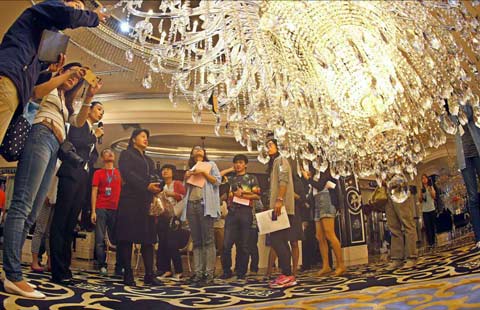
While the week brought a vast array of ideas from designers around the world, Geo-City Smart City, curated by the China Millennium Monument Museum of Digital Arts, was the focus feature, displaying 82 projects from 14 countries.
GeoPulse Beijing, the Beijing-focused pilot demo by ARS Electronica of Austria, was one of the Chinese applications of this model on display, and its overall message was clear: Smart cities are the way of the future, and now is Beijing's time to embrace it.
Some predict that by 2050, between 70 and 85 percent of the global population will live in cities, but the problems of over-urbanization — pollution, traffic, overcrowding — are already starting to show. The idea of GeoCity is to put government and citizens' fingers on the urban pulse, and show how they can solve these problems.
The solution? Big Data. In the modern world, the magnitude of open data from social networks, smartphones and other means is phenomenal, yet barely any is being harnessed. According to the GeoCity initiative, if this data is collected, processed and understood, the possibilities for helping urbanization are huge.
"The first time we had it developed for the city of Linz (in Austria) in its first phase, it was a tool for the citizens," said Michael Badics, director of AE Solutions at ARS Electronica."From kids to the elderly, everyone could access this data. But we saw there was so much more potential in it."
Smart Cities will also give governments the ability to access information about the city and solve problems more efficiently. But to be understood, the data must be visual and accessible, and that's where the project's second proposal comes in: Big Design. ARS Electronica has paired with the Academy of Arts and Design at Tsinghua University, among others, to find ways of mapping urban mobility that's visually stimulating and easy to understand.
"Visually telling stories gives us the possibility to explain things and make them open for people," Badics said during his keynote speech during the design week."Out of the data hidden in the city, you can tell stories. And you can tell stories in a way that people can really understand how the things are connected."
According to Fu Zhiyong, vice-director of Information Art and Design Department at Academy of Arts and Design, Tshinghua University, information visualization has grown quickly in China during the past 10 years.
"It's all about navigating and delivering the message, which gets people participating and makes the city smart," he says.
Oliver Senn, a senior research engineer with Singapore-MIT, gave an example of how data collection could be used by taxi drivers. Drivers could be warned when it is going to rain and shown a visualization of where the most potential passengers are located.
But GeoPulse Beijing is more than a convenient idea - it's a way of understanding an inevitable future. The question is, will Beijing embrace the idea with open arms? Yang Lei, curator of the GeoCity exhibition, seems to think so.
"It's already started. We used this exhibition to launch some pilot demos," he says."In China, everything is happening so fast. In the next three to five years this data-based Smart City movement will really take off."
Contact the writer at chennan@chinadaily.com.cn


Copyright 1995 - . All rights reserved. The content (including but not limited to text, photo, multimedia information, etc) published in this site belongs to China Daily Information Co (CDIC). Without written authorization from CDIC, such content shall not be republished or used in any form. Note: Browsers with 1024*768 or higher resolution are suggested for this site.
License for publishing multimedia online 0108263 Registration Number: 130349