Comments()
  Print
Print  Mail
Mail  Large Medium Small
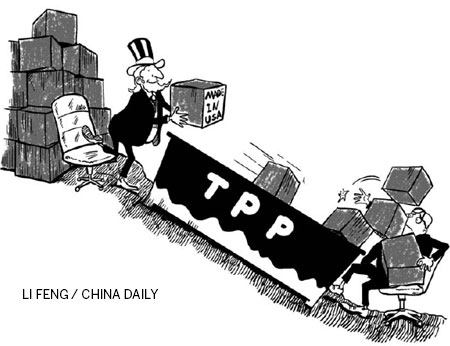
The 14th round of negotiations on Trans-Pacific Partnership begins at Leesburg, Virginia, in the United States from Sept 6. The TPP is a significantly expanded version of the Trans-Pacific Strategic Economic Partnership Agreement and Washington is keen on wrapping it up before the presidential election in November for obvious reasons.
The nine countries that will negotiate the TPP are Australia, Brunei, Chile, Malaysia, New Zealand, Peru, Singapore, Vietnam and the US. Once finalized, the TPP will be the largest trade block in the Asia-Pacific region, and could become even larger once Canada and Mexico join the discussions. Japan and the Republic of Korea could follow suit.
The TPP is an ambitious trade agreement covering several issues. It includes trade in goods, tariffs and services, cross-border investment, rules on intellectual property rights (IPR), environmental and labor standards, and technical barriers to trade. The agreement is also trying to make regulatory systems in member countries as compatible with each other as possible. And the negotiations will include government procurement, trade and investment in innovative products and services, particularly digital technologies.
The US is pushing the agreement because it considers Asia-Pacific the biggest source of economic gains for its industries. Greater trade integration of American companies with Asia-Pacific economies will create new jobs in the US and increase export earnings. The TPP, prepared and implemented in line with business interests of US industries, will create a favorable atmosphere for the American economy's long-term recovery.
But the TPP has given rise to several concerns. The first is that the agreement maximizes US business interests and minimizes those of others. The agreement proposes strong and rigid IPR rules, using the bilateral free trade agreement between the US and the ROK as the benchmark.
The US-ROK free trade agreement provides strong protection to patents, trademarks, geographical indications and copyrights for digital products and also strong penalties for IPR infringements. It criminalizes end-user piracy and empowers customs officials to act against products suspected to be counterfeits without waiting for formal complaints.
There will be serious implications if similar or even stronger rules are reproduced in the TPP. They will allow patent holders to issue criminal proceedings on the slightest suspicion of piracy and give Customs sweeping powers to stop entry of pirated products. Both these powers can be misused, and emerging market products using small variations on patented products will suffer the most.
The US is keen on including strong IPR rules in the TPP because it issues the maximum number of patents and copyrights, and wants the highest protection for its patent holders. While these rules will allow US products easy entry into other countries, similar products from other countries may be denied access to the US market on grounds of piracy. Rigid IPR rules are likely to discourage innovation and increase global disputes over violation of patents, as is evident from the patent war between Apple and Samsung.
The second concern is that the TPP attempts to create a major trade block without some of the biggest emerging economies. None from the BRICS group - Brazil, Russia, India, China and South Africa - is part of the TPP. While the countries negotiating the TPP are all members of the Asia-Pacific Economic Cooperation, some major APEC economies - the Chinese mainland, Hong Kong, Taiwan, Indonesia, Russia and Thailand - are not included in the negotiations.
China's exclusion is strange given its huge economic presence in Asia-Pacific. This has given rise to views that the US is driving the TPP with the strategic objective of marginalizing China.
Another concern with the TPP is its impact on Asian integration. Various models of economic integration are being pursued in Asia. These include Free Trade Area for the Asia-Pacific by APEC, Comprehensive Economic Partnership for East Asia by the East Asian Summit and the East Asia Free Trade Area by ASEAN, China, Japan and the ROK. All these efforts will be hampered by the advent of the TPP, which will add a strong "non-Asian" flavor to economic integration efforts in Asia and force Asian economies to develop different strategies for regional integration.
The complications created by the TPP are becoming visible in Asia. Japan and the ROK, while expressing interest in the TPP, are also negotiating on the EAFTA. The dilemma of choosing between the TPP and other Asian trade frameworks will affect more Asian economies.
Emerging markets like China, Brazil and India will find it difficult to join the TPP, given its rigid rules and the US dominance. But to ensure that the TPP does not divert global trade from them, they will need to act together. The best thing for them to do would be to expedite BRICS' development so that it can provide an alternative trade framework to the TPP by creating rules that are easier to implement and follow by emerging market industries. A strong BRICS structure will also strategically balance global trade, which could otherwise be dominated by the TPP.
The author is head (partnership & programmes) and visiting senior research fellow at the Institute of South Asian Studies, National University of Singapore.
Copyright 1995 - 2010 . All rights reserved. The content (including but not limited to text, photo, multimedia information, etc) published in this site belongs to China Daily Information Co (CDIC). Without written authorization from CDIC, such content shall not be republished or used in any form. Note: Browsers with 1024*768 or higher resolution are suggested for this site.
License for publishing multimedia online 0108263 Registration Number: 20100000002731