Comments()
  Print
Print  Mail
Mail  Large Medium Small
|
 |
|
An employee checks the wine in the barrels of red wine in the cellar of Chateau du Grand Moueys in Capian March 7, 2012. Chinese businessman Jin Shan Zhang is the new owner of Chateau du Grand Mouey's estate and his purchase is part of a wave of Chinese investment in the Bordeaux region to satisfy domestic demand for French wines. In the summer of 2013, the Chateau will be turned into a luxury hotel with French gardens, tennis courts, a golf course and a high-end Chinese restaurant. [Photo/Agencies] |
Chinese investors have been picking off Bordeaux's best, to satisfy a growing thirst back home
As the global economic downturn hits Western demand for French wines, Chinese buyers are being viewed as the saviors of the industry.
The Bordeaux wine region, most recognized by Chinese consumers, has seen a three-digit growth in its exports to China since the country overtook the UK and Germany to become its largest client in 2010.
According to figures released by the Bordeaux Wine Council, or CIVB, China imported 58 million bottles of wine worth 334 million euros ($410 million) from Bordeaux in 2011 - an increase of 103 percent on the previous year. The sales value generated from the Chinese market, including Hong Kong, now accounts for 35 percent of Bordeaux's total wine exports.
The lucrative region has seen Chinese State-owned companies, such as COFCO Group, as well as private businessmen, flocking to the region to acquire vineyards and chateaux in the hope of gaining control of supplies and eliminating intermediaries in the distribution chain to expand profit margins.
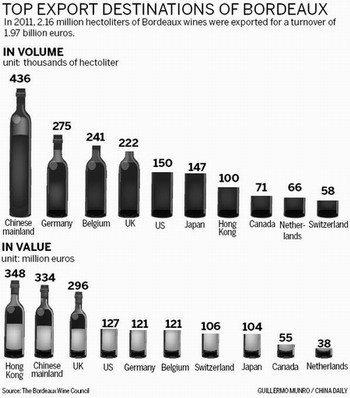
It is estimated that more than 25 chateaux in Bordeaux have been bought by Chinese companies or individuals in the past year, and 30 more are expected to close deals by the end of this year.
And despite the recent price plunge of top-growth Bordeaux wines, and concerns over a bursting bubble inflated by the surge of China's interest in luxury goods and Western tastes, wine experts suggest there is unlikely to be any letup soon in the growing Chinese thirst for French fine wines.
Lushang Group, a State-owned conglomerate in Shandong province, has already shipped 150,000 bottles of wine worth 400,000 euros back to China since it purchased the little-known Chateau de Gugat from a Swiss owner a year ago in the Blasimon region near Bordeaux.
"The production capacity of the chateau is about 220,000 to 250,000 bottles per year, which is far from meeting the demand at home.
"With our strong distribution and retail network, it can be sold instantly," said Tan Xingang, general manager of the chateau.
Setting up a wine trading entity in Bordeaux, added Tan, is the Shandong company's next step, which will enable it to not only sell its own wines but also gain a much wider access to wines from neighboring estates and other wine brokers.
The company isn't the only one to be eyeing the potential opportunity in the traditional "negociant" trading system of the Bordeaux wine market, which sees a wine merchant assemble the produce of smaller growers and winemakers and sell the result under its own name.
A recent move by Chinese group Bright Food, acquiring 70 percent of shares of Diva Bordeaux, a leading wine trading company, has heralded a trend of Chinese companies expanding from vineyard and chateau purchases to investing in the wine trading business.
Bright Food's move caught some in the industry by surprise, as it was the first time that a Chinese company had invested in a Bordeaux negociant.
French newspaper Le Figaro described the deal as a step by Chinese investors to "finally plant the flag in the heart of French gastronomy".
Xu Qinghua, head of China business services at accounting firm Ernst & Young in France, said of the move: "In my view, the deal with Diva is a genius move by Bright Food, as the wine trading business is usually the most value-adding in terms of brand creation and brand management, as well as the most profitable in the wine industry supply chain.
"And wine traders are the ones who have the most up-to-date market intelligence."
Xu believes it will give the company access to a much wider range of wines, get a sniff of the market and identify first hand those most in demand by Chinese consumers.
It may also help pave the way for future acquisitions by Bright Food and give it the advantage of being the first to shape the taste of the relatively immature Chinese wine market.
For Diva Bordeaux, the investment reinforces the company's capital position and brings it closer to China's huge customer base, which already accounts for 45 percent of its total sales, said its managing director, Jean-Pierre Rousseau.
The company posted a total turnover of 33 million euros last year, and Rousseau thinks with the help of Bright Food, it can easily double that in three to four years.
Ripening enthusiasm by China's growing wealthy and middle classes for luxury goods and a Western lifestyle has meant a massive rise in wine consumption in the country.
Eager to go with the flow, to date, most Chinese investors have been targeting mid-range chateaux in Bordeaux at a cost under 10 million euros.
With a ready-made distribution and retail network back home, new Chinese chateaux owners usually ship their entire production back to China.

 Michelle Obama addresses at Democratic National Convention
 Slides of Yanbian: place, people and prosperity
 Washington to remain focused on Asia-Pacific
 RQFII target blue chips amid bear market
 Australian recall for top two exporters
 China fears new car restrictions
Copyright 1995 - 2010 . All rights reserved. The content (including but not limited to text, photo, multimedia information, etc) published in this site belongs to China Daily Information Co (CDIC). Without written authorization from CDIC, such content shall not be republished or used in any form. Note: Browsers with 1024*768 or higher resolution are suggested for this site.
License for publishing multimedia online 0108263 Registration Number: 20100000002731