Bright prospects
"There is no doubt that Brazil will be a star country in the next decade," said Xu from Sany.
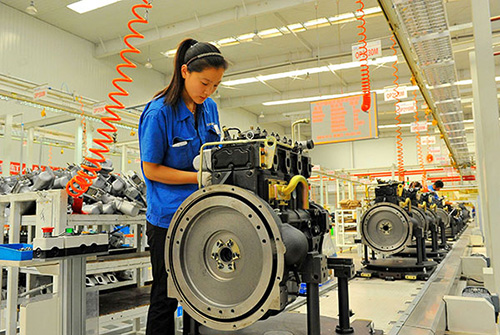
For his company, its Brazilian production base is being seen as a perfect springboard for products to be sold into other Latin American countries.
"Colombia, Peru and Ecuador, all these countries boast enormous market potential," he added.
Improved stability expected in the region in the long term also provides Chinese companies with a further reason to be optimistic, not least because of the strengthening ties in recent years between China and Mercosur - South America's leading trading bloc, known as the Common Market of the South, which aims to bring about the free movement of goods, capital, services and people among its member states.
"South American countries' economic policies are distinctively cyclical," added Yue from the Chinese Academy of Social Sciences.
"Over the past decade they became gradually protective against foreign countries, but will open up again in the future."
During his recent four-nation visit to South America in June, Premier Wen Jiabao signed several trade and cooperation agreements with the countries he visited.
In Brazil, the two countries signed an accord to swap $30 billion worth of their currencies. Brazil and China also announced plans to share more financial information and enhance cooperation and investment in aerospace.
In Argentina, Wen and Argentina's President Cristina Fernandez signed accords on nuclear energy and for Chinese imports of Argentine horses and livestock, and some farm products. The two countries also inked a deal of a $2 billion loan to finance the upgrading of Argentina's Belgrano Cargas railway.
China currently has free trade agreements with Latin American countries, including Chile, Peru and Costa Rica.
And during a discussion between the two leaders, Wen and Fernandez talked about a free trade agreement between China and the Mercosur bloc.
Wen said he expected bilateral trade between China and Mercosur to reach $200 billion by 2016, up from $99 billion in 2011, Argentine official data showed.
For TEQSA, Wen's visit to Argentina marked a great opportunity to push for progress.
After rounds of stalled negotiations, a conclusion was finally reached that will see TEQSA selling a portion of its stock to an Argentine state-owned company and a private Argentine company, forming a new joint venture, the company said.
There are conditions attached: any equipment and machinery needed in the project, unless Argentine manufacturers cannot produce them, must be purchased in the local market, and the company should also employ as many local people as possible.
As a result, "the costs will be much higher than before and the company structure, which is already very intricate with people from three Chinese companies, will be further complicated", said Li Dacan, its general manager.
But Li said he is optimistic about the future prospects it presents.
Argentina currently consumes about 10 percent of the world's fertilizer but can produce only 4 percent.
"Everything will be fine if the plant starts production," he said.
Li also plans to put his years of experience in dealing with the Argentine government and local market to good use.
His next plan is to build an industrial park in Rio Grande, a tariff-free zone designated by the Argentine government, and invite more Chinese companies to invest.
"We have paid our dues. All these things can never be learned if we had stayed in China. And now we will make use of the experience to build a platform for other Chinese companies," Li said.

Copyright 1995 - . All rights reserved. The content (including but not limited to text, photo, multimedia information, etc) published in this site belongs to China Daily Information Co (CDIC). Without written authorization from CDIC, such content shall not be republished or used in any form. Note: Browsers with 1024*768 or higher resolution are suggested for this site.
License for publishing multimedia online 0108263 Registration Number: 130349