Comments()
  Print
Print  Mail
Mail  Large Medium Small
|
 |
|
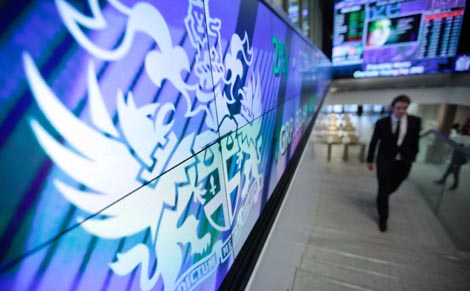
Outside the London Stock Exchange in the City of London. London is now a yuan offshore trading center, which will help both Chinese and European business people to avoid foreign exchange risks. [Photo/China Daily] |
Currency is fast becoming a key topic of conversation for bankers, reports Diao Ying in London.
The fashionable youths in hot pants flocking to high-end department stores in London and bankers in dark suits walking in and out of skyscrapers in the financial district have one thing in common, a growing interest in the Chinese currency.
During the recent holiday to celebrate the Diamond Jubilee of Queen Elizabeth II, Harrods, a department store known for its ties with the British royal family, launched its own Sina Weibo, a popular Chinese social media platform, to attract more Chinese customers. Shoppers can find "the very latest, limited edition and exclusive products", with Hermes, Chanel and Louis Vuitton among the most popular brands, according to the store's spokesman.
More than 100 UnionPay payment terminals in the store also help to make Chinese shoppers feel more at home. Through the machines, part of China's unified bank card network, Chinese visitors can pay for their purchases with the same cards they use at home.
A few streets from Harrods, a billboard featuring a green jade dragon shaped like the yuan symbol stands outside a bank. The ad reads: "A new global currency is emerging. Be part of it." The commercial is for HSBC, a bank rooted in the silk and tea trade between China and Britain in the 19th century.
The UnionPay terminals, the jade dragon advertisements and the shops on the streets of London offering exchange services between the British pound and the yuan are the tip of the iceberg in the biggest story in the financial markets today: the internationalization of the Chinese currency.
As people search for a bright spot amid sluggish economic growth in the West, beset as it is by the European debt crisis, companies, investors and financial institutions are increasingly focused on the yuan. From Beijing to Hong Kong, Tokyo to London, policymakers and businesses are part of the push.
There are several forces driving this move, both at home and abroad. The People's Bank of China has made several moves this year to liberalize the exchange rate; George Osborne, the UK chancellor of the exchequer, took the initiative to develop London into an offshore trading center for the yuan earlier this year; and this month, the yuan became convertible with the Japanese yen under an agreement between the Chinese and Japanese governments.
"All of it demonstrates that the Chinese government is pushing forward the internationalization of the yuan and encouraging the use of yuan offshore. That will help the global economy in many ways," said Adam Tyrrell, head of European capital markets for Standard Chartered in London.
Greenback to redback
These initiatives will have a profound influence on the development of trade. For instance, China and Europe are each other's largest trading partners, but, up till now, the bulk of that trade has been settled in the US dollar. If a Chinese company buys pork from a UK company, it does not buy and sell in yuan, the pound or the euro. It settles in dollars.
That paradox is changing. Now the same pork company can open a yuan account at a British bank such as HSBC or Standard Chartered, or a Chinese bank that operates in Europe, such as Bank of China or Industrial and Commercial Bank of China, and can then invoice the goods or settle the deal with its Chinese clients in their national currency.
The advantage of this is clear: Settling in yuan helps both sides to avoid foreign exchange risks and reduces transaction costs. For instance, in 2008, many companies in southeast China had to lay off workers and close factories because they were losing money through currency appreciation. That situation would have been different if the contracts had been signed in yuan, because the agreements would have a fixed value no matter what the change in the exchange rate.
The initiative can also benefit companies outside the European time zone, given London's position as the world's foreign exchange center. "The beauty of London is not just about London," said Patrick Law, Hong Kong-based managing director and head of trading for Greater China at Barclays. "If you look at the London time zone, it covers both the northern and southern hemispheres." And that means it will also help facilitate business between China and Africa and the Middle East.
"Africa is a very interesting market to look into because China and Africa have a lot of business together," Law said. He added that Barclays, a bank with strength in commodity trading, began to conduct trade between the South African rand and yuan from April.

 Michelle Obama addresses at Democratic National Convention
 Slides of Yanbian: place, people and prosperity
 Washington to remain focused on Asia-Pacific
 RQFII target blue chips amid bear market
 Australian recall for top two exporters
 China fears new car restrictions
Copyright 1995 - 2010 . All rights reserved. The content (including but not limited to text, photo, multimedia information, etc) published in this site belongs to China Daily Information Co (CDIC). Without written authorization from CDIC, such content shall not be republished or used in any form. Note: Browsers with 1024*768 or higher resolution are suggested for this site.
License for publishing multimedia online 0108263 Registration Number: 20100000002731