Comments()
  Print
Print  Mail
Mail  Large Medium Small
 |
|
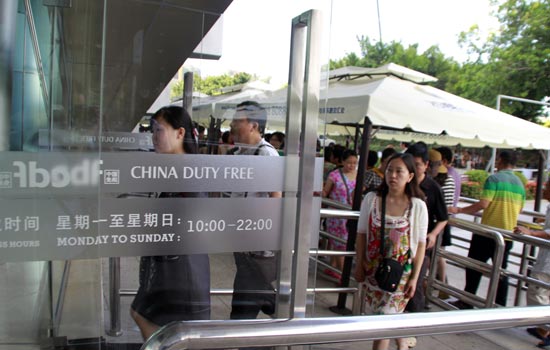
Chinese people entering the China Duty Free Store to buy imported goods in Sanya, in South China's Hainan province. The store has had daily average sales of more than 5 million yuan ($794,000) since it started business in April last year. Chinese demand for overseas consumer goods, especially luxury products, is huge.?[Photo/ China Daily] |
Tariffs expected to be lowered on raw materials, daily necessities and technology
Recent government policies that are expected to lower the tariffs on some raw materials, daily necessities and advanced technology machines and parts have sent positive signals, a senior economist said.
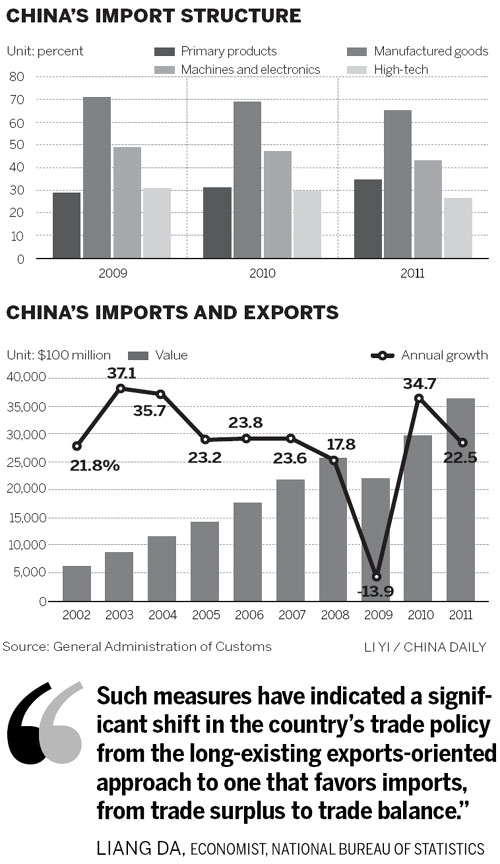
"Such measures have indicated a significant shift in the country's trade policy from the long-existing exports-oriented approach to one that favors imports, from trade surplus to trade balance," said Liang Da, an economist with the National Bureau of Statistics.
A circular entitled Advice on Strengthening Imports and Promoting a Balanced Development of Trade was recently published by the State Council.
China's volume of imports grew at an annual rate of 16.4 percent on average between 1979 and 2010, 0.8 percentage points lower than the growth rate of exports.
Of them, the annual growth rate of 20 percent on average between 2001 and 2010 is 0.3 percentage point lower than the growth in exports.
The country's foreign trade rose 14.1 percent year-on-year to about $343 billion in May, rebounding from 2.7 percent growth in April, according to the General Administration of Customs, which released the data on June 10.
The figure replaced the monthly trade record set in November 2011, when foreign trade amounted to $334.11 billion, GAC said.
Both imports and exports reached record highs in May. Exports grew 15.3 percent from a year earlier to $181 billion and imports increased 12.7 percent to $162 billion.
The better-than-expected data showed China's foreign trade has recovered, said Huo Jianguo, director of the Chinese Academy of International Trade and Economic Cooperation under the Ministry of Commerce.
But the country should still be cautious about the long-term trend, Huo said, citing uncertainties over the eurozone debt crisis.
Huo said improving markets in the United States and Japan, stable growth in emerging economies and less pressure for the yuan to rise further also helped boost May's trade data.
However, some analysts warned that the rebound may not be sustainable.
Zhang Hanlin, head of the China Institute for World Trade Organization Studies with the University of International Business and Economics in Beijing, said the risk of a declining economy is increasing. The number of orders at major trade fairs since May has not been good, he said.
Zhang said the solid implementation of government policies encouraging imports will speed up their growth and balance the trade volume this year.
Import volumes as a major indicator of the health of the domestic economy should be encouraged, some experts said.
Expanding imports has been a solution to alleviate the shortage of resources and energy, which have experienced a rapid rise in demand because of the fast growing economy, said Liang Da with the NBS.
In addition, according to recent data, a sharp increase in investment often comes with the rapid growth of imports, he said, adding imports are also closely related with industry profit margins and the exports of manufacturers.
Imports of consumer products will play a better role in stimulating domestic consumption, Liang said. Previous import commodities focused on industrial use. Now the instruction to boost the purchase of foreign goods will increase and restructure overall consumption and encourage manufacturers to upgrade the quality of their products.
Lowering the tariffs on consumer products will give a boost to the buying power of higher-income groups, said Liang.
For example, the textile and clothing industry, with its exports taking up more than 30 percent of total world exports, carry a high tariff on imports. The prices of some high-end products such as designer goods are much higher domestically than they are overseas.
In 2009, the Chinese spent $12 billion on luxury items abroad and $9.4 billion in the domestic market.
The decrease in tariffs will increase domestic sales and develop the huge purchasing potential of the middle class, Liang said.
Such policies will also increase collaboration in high technology and emerging industries and reduce trade disputes, he added.
wangzhuoqiong@chinadaily.com.cn
Copyright 1995 - 2010 . All rights reserved. The content (including but not limited to text, photo, multimedia information, etc) published in this site belongs to China Daily Information Co (CDIC). Without written authorization from CDIC, such content shall not be republished or used in any form. Note: Browsers with 1024*768 or higher resolution are suggested for this site.
License for publishing multimedia online 0108263 Registration Number: 20100000002731