|
 |
|
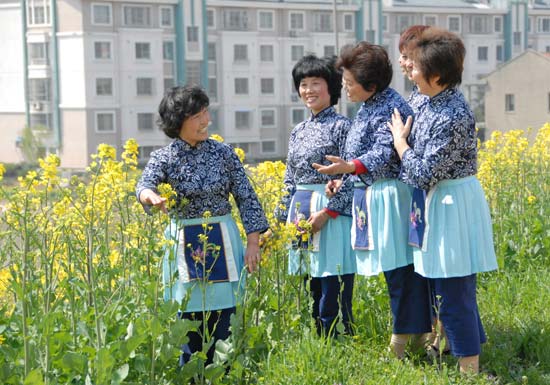
Villagers sing folk songs, which have been passed down for hundreds of years in the Heyang Mountain area in Zhangjiagang. [Photo/China Daily] |
The company gave him a 30-sq-m apartment in 1998 and a larger two-room apartment later. Dai bought a 143-sq-m apartment in 2007. While Dai's life got better, he also saw Zhangjiagang, which started its development strategy in 1962, transform into what many hail as "rural China's future". He hopes his son, who studies at a normal university in Jiangsu's Huai'an city, will move to Zhangjiagang.
"I still worry about my hometown," he says. "It's still not so rich. I hope it can catch up with Zhangjiagang." But that would require a mindset shift, he says. "Zhangjiagang is more advanced and realizes money is just one side of development," he explains. "People should also volunteer, observe social responsibility and pay attention to education. That's a different form of development."
But Zhangjiagang's reincarnation didn't happen overnight. Wang Yutian, who left Zhangjiagang to become a tailor in Liaoning province's Dalian city in 1984, says change was difficult. "Farmers' houses were messes," Wang says. "They would move into new buildings but keep old habits. They didn't tidy up and wouldn't throw anything away because it might be useful later. The transformation took time."
Wang returned in 2000 to open restaurants and then a logistics company. Since 2006, he has run a home repair hotline service in an industrial park. Such hotlines are common in Zhangjiagang and help with anything from a broken water heater to a domestic dispute. Having worked as a migrant and possessed a rural hukou before he got a "family" residency permit, Wang says he appreciates migrants' contributions to his hometown.
"Without migrants, we couldn't have developed so fast," he explains.
Migrant worker Liang Jingquan, who runs the same kind of business as Wang, agrees. "Every city needs migrants. The term 'new citizen' sounds more like a family member than an outsider. That's good. Migrants should be treated like family - not just service providers."
Liang got a Zhangjiagang hukou when he bought a 42-sq-m house for four people in 2003 for 200,000 yuan.
"Before I had the hukou, I didn't have social security or health insurance," Liang says. "Previously, your son was your insurance. Now you can get it from the government."
Liang moved to the city in 1990 at age 21. After toiling in textile plants, he opened a supermarket in 1996. When he realized local people were buying more cars, he opened a carwash. The Happy Harvest repair hotline service he founded in 2006 now employs 12 "new citizens". He believes it would be difficult for his hometown to replicate Zhangjiagang's model.
"If a rich man invests in my hometown, I'm not sure it could pay off like it has in Zhangjiagang," Liang says. "Think of industries as clothes and cities as people. A poor person with only one set of clothes doesn't have a choice - even if those clothes are dirty rags, he still has to wear them. But a rich man can choose from several sets of clothes. In the same way, my hometown must take whatever industry it can get, even if it pollutes, while Zhangjiagang can choose."
Northern Jiangsu, where Dai and many migrants in Zhangjiagang come from, is poorer, and southerners often look down on his ilk, he says.
"Fewer people look down on us now. I don't feel like an outsider anymore. I feel like a new citizen."
Contact the writers at chenjie@chinadaily.com.cn and erik_nilsson@chinadaily.com.cn.

Copyright 1995 - . All rights reserved. The content (including but not limited to text, photo, multimedia information, etc) published in this site belongs to China Daily Information Co (CDIC). Without written authorization from CDIC, such content shall not be republished or used in any form. Note: Browsers with 1024*768 or higher resolution are suggested for this site.
License for publishing multimedia online 0108263 Registration Number: 130349