

 Comments()
  Print
Print  Mail
Mail  Large Medium Small
Increases in electricity use, regarded in China as a key indicator of the economy's true condition, has been lagging GDP expansion in recent months, and economists can't say definitely why.
In the first quarter, even as GDP expanded 8.1 percent, electricity use rose only 6.8 percent. That was in sharp contrast with an increase in use of 12.7 percent recorded a year earlier, the National Energy Administration said last week.
|
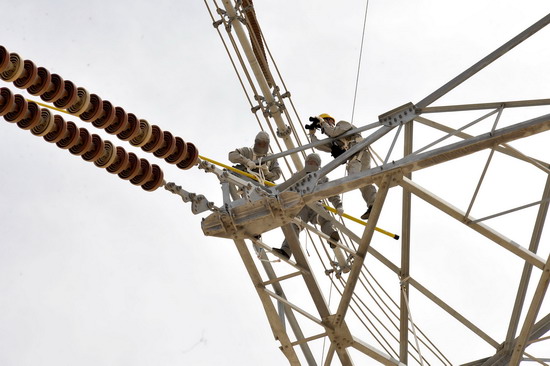 |
| Workers from Gansu Electric Power Company repair a pylon on the section of the grid between Hexi and Jiuquan in Gansu province on May 17, 2012.?[Photo /?China Daily] |
In the first four months of this year, electricity use increased even more slowly, at 6 percent, against a year-earlier gain of 11.2 percent.
Most economists expect second-quarter GDP growth of 7.9 percent or less. But at least in April, electricity use edged up 3.7 percent, the lowest rate in 16 months. Industrial electricity use was up just 1.55 percent.
"Such a rapid slowdown (in the increase in electricity use) was unexpected," said Han Wenke, director of energy research at the National Development and Reform Commission.
The decline in the increase of electricity use clearly indicates that China's economic slowdown is accelerating, and the government must pay close attention to it, said Lin Boqiang, director of the China Center for Energy Economic Research at Xiamen University.
Electricity use has long been looked at by many people, including Vice-Premier Li Keqiang, as a more reliable indicator of economic health than GDP.
Partly, economists said, the slowdown in electricity use increases reflects the lackluster state of manufacturing. Industrial output expanded 9.3 percent in April, falling below 10 percent for the first time since June 2009. It could also reflect that some companies in energy-intensive sectors, such as metal and chemicals, have closed or are running below capacity.
Economist also caution that the gross figure for electricity use has limits and it's important to analyze the data.
Huang Yiping, a Peking University professor in economics, said that the headline figure should not be given "excessive" significance.
Zhang Monan, an economist with the State Council Information Center, noted a long-term trend of energy-intensive operations moving from industrialized coastal areas, as those regions shift to low-carbon growth models.
Zhang said this shift might be playing a larger role than short-term economic factors.
China consumed 1.555 trillion kilowatt-hours of electricity in the first four months of the year. Breaking the total down, official data show the following:
Primary industry, such as farming, used 26.7 billion kWh, down 4.2 percent year-on-year. Secondary industry, which includes manufacturing, mining and utilities, used 1.129 trillion kWh, up 3.7 percent. Tertiary industry, or the services, used 181.7 billion kWh, up 12.4 percent.
Residential use was 217.6 billion kWh, up 15.39 percent.
Looking at industrial use from a different perspective, heavy industry's power consumption was up 3.84 percent in the first four months, while that of light industry expanded just 2.61 percent.
Another striking statistic: In the first quarter alone, power use by the construction and metallurgical industries actually declined, by 2 percent and 5.4 percent, respectively.
The outcome varied by region, too, with most places recording slower growth in power use in the first quarter.
Except for Henan, Heilongjiang, Shanxi and Beijing, all the other 27 provinces, municipalities and autonomous regions reported a decline in electricity use growth in the first quarter.
The China Electricity Council forecast that a recovery in industrial activity could lead to a gradual rise in electricity generation and use in the second and third quarters, along with a rise in the demand for thermal coal.
However, the growth rate of electricity use will still be lower than it was in the third quarter of 2011.
dujuan@chinadaily.com.cn
Copyright 1995 - 2010 . All rights reserved. The content (including but not limited to text, photo, multimedia information, etc) published in this site belongs to China Daily Information Co (CDIC). Without written authorization from CDIC, such content shall not be republished or used in any form. Note: Browsers with 1024*768 or higher resolution are suggested for this site.
License for publishing multimedia online 0108263 Registration Number: 20100000002731 
