 |
|
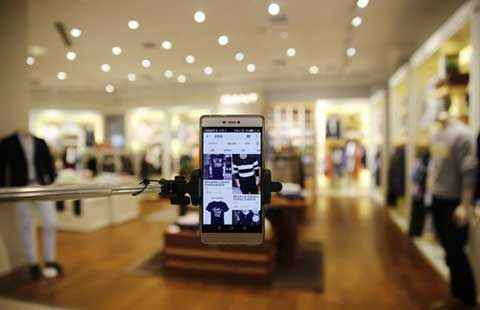
China's online advertisement volume reached 14.06 billion yuan ($2.23 billion) during the first quarter of this year, up 58 percent from the same period a year ago. [Photo/China Daily] |
When Zheng Bin, chief executive officer of hdtMEDIA, introduced "rich media" to China a decade ago, the advertising landscape then was unsaturated.
Television was the dominating channel for commercial advertising, while newspapers and radios, although less popular, readily took a piece of the pie. Few considered investing in the Internet, a then fledgling industry.
But now, the tide has turned and things are heading toward the side of online advertisers. The proportion of online advertising in overall advertising spending rose from 1.56 percent in 2005 to 5.2 percent in 2010 and is expected to hit 9 percent in 2016, domestic research group CTR showed.
The value of online advertising amounted to 14 billion yuan in the first quarter of 2012, a sharp rise of 58 percent from a year earlier, according to IT data provider iResearch.
"Rich media ad" is a term used for online advertising that incorporates the use of photorealistic 3D, flash technology and interactive online applications. It presents itself in the form of short video clips, interactive cartoons or even quiz games.
When a consumer browses a website, rich media provides the necessary technology to transmit the marketer's message directly to the consumer's desktop, where they can effortlessly interact with the marketer's brand.
"When we first embarked on the cause, there was nothing but suspicion," Zheng said. The prime concern, he recalled, was whether there was enough bandwidth to present to viewers the vivid content.
But luckily, fueled by the fast development of information technology and the fact that the Internet has grown from the margins to the mainstream, rich media ads have become widely applicable.
As a pioneering company in the digital advertising sector, hdtMEDIA has served more than 5,000 clients in a variety of industries, ranging from consumer goods to telecommunication services. Now, tailor-made online ads appear on almost every popular Chinese portal, linking online platforms and marketers.
The one change rich media has gone through is to ride the "mobile" boom. The company established a mobile advertising network in 2010 (hdtMobile), covering the top 1,000 major mobile applications and mobile sites in China.
"We support videos, flash, images and text link ad formats and can be automatically adapted to different mobile device types. To avoid the traditional intrusive ad model, we allow users to opt in or opt out of receiving the ads," he said.
A revolutionary trend would be the location-based services called "check-in" on mobile devices, when a user whips out his smart phone, launches an application such as Weibo or Renren and taps a button to tell his friends where he or she is, according to Zhang Jihong, market director of research firm GroupM China.
For instance, if a user "checks in" at a cafe, the merchant can then follow that person's activities in real time, with the next advert appearing on his micro blog page possibly being coffee or dessert or other relevant offerings.
Compared with 10 years ago, online advertisers are also able to direct messages based on demographics, income and even location, Zheng said.
The Internet has turned everybody transparent, according to a new survey conducted by consultancy McKinsey & Co. Chinese consumers are the "most active" population that rely on social networking sites before a purchase, spending on average 46 minutes a day viewing, forwarding and commenting on posts on these sites.
In this way, websites people viewed and comments they made have become labels that identify the person's gender, interests and whereabouts, creating unique opportunities for merchants to locate their target audiences, the report said.
"Perhaps a consumer would hardly notice the shift, except that ads might seem more relevant to exactly what they are shopping for," he said.
Moreover, hdtMobile's database can precisely target ads to the relevant audiences, providing real-time ad displays, automatic updates and data analysis. Therefore, marketers can essentially follow that person's activities in real time, deciding when and where to show him near-personalized ads throughout the Web.
The practice addresses the one element that has been largely missing in online advertising: immediacy.
The company has recently launched a new advertising exchange platform, hdtDXP, allowing advertisers buy ads in the milliseconds between the time someone enters a site's Web address and the moment the page appears. The technology, called real-time bidding, allows advertisers to examine site visitors one by one and serve them ads almost instantly.
The marketplace creates a pool of advertising inventory and brings buyers and sellers of online display advertising together. Buyers can create ad programs with precise targeting, defined bids and budgets and frequency caps on purchases.
The bidding is ideal for publishers, according to statistics revealed by Google's DoubleClick Ad Exchange, a similar platform, in 2011. Advertisers are willing to pay 130 percent more for targeted ads than through conventional methods.
"The biggest challenge for hdtDXP is to make decisions of what ads to show and what price to bid for each impression in such a short period of time. And this is what we are trying to address," Zheng said.
hewei@chinadaily.com.cn


Copyright 1995 - . All rights reserved. The content (including but not limited to text, photo, multimedia information, etc) published in this site belongs to China Daily Information Co (CDIC). Without written authorization from CDIC, such content shall not be republished or used in any form. Note: Browsers with 1024*768 or higher resolution are suggested for this site.
License for publishing multimedia online 0108263 Registration Number: 130349